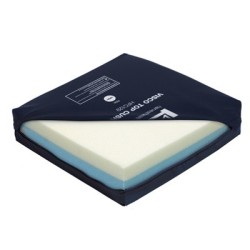
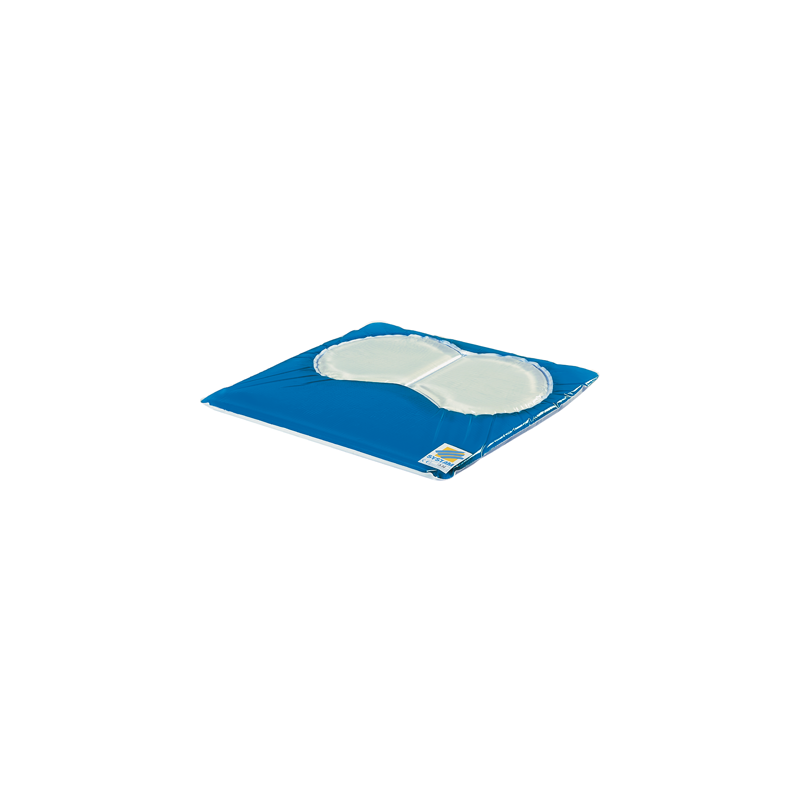


The Duogel Cushion provides low-risk seated pressure redistribution using two distinct gel zones within a single thin surface: white fluid gel at the high-pressure pelvic and ischial zones for active redistribution, and blue viscoelastic gel at the surrounding zones for structural containment. Suitable for wheelchairs, armchairs, and beds. Water-resistant cover for wipe-clean decontamination. SWL 140kg. 420 x 420mm. 3-year warranty. Low-risk indication per NICE CG179. MDR 2017/745 Class I medical device.
| Specification | Detail |
|---|---|
| Material | Two-part viscoelastic gel (no foam base) |
| White Gel Zone | High-reticulation fluid gel for pressure redistribution at pelvic and ischial sites |
| Blue Gel Zone | Viscoelastic gel for lateral stability and fluid migration prevention |
| Cover | Water-resistant |
| Dimensions | 420 x 420mm |
| Safe Working Load | 140kg (22 stone) |
| Reference | NCL-P311D |
| Warranty | 3 years |
| Clinical Risk Level | Low risk per NICE CG179 |
| Regulatory Status | MDR 2017/745 Class I medical device |
The Duogel Cushion is a Class I medical device under MDR 2017/745. Clinical selection requires assessment confirming low-risk status per NICE CG179; the Duogel is not appropriate for residents assessed at medium, high, or very high pressure risk, who require a higher-specification seating cushion. SWL of 140kg must be verified per MHOR 1992 before issue. Equipment register records and MDR conformity documentation must be retained for CQC Regulation 12 compliance.
How does the Duogel differ from the Gel Cushion (pure gel) and the Duoform Cushion (gel on foam)?
All three use gel as part of their pressure redistribution mechanism, but the construction and clinical application differ significantly. The pure Gel Cushion is a single uniform viscoelastic gel layer at 25mm depth, providing general conforming redistribution for low-to-medium risk residents. The Duogel uses two distinct gel types - fluid gel and viscoelastic gel - in specified zones within a gel-only construction, targeting the highest-pressure sites with fluid gel while providing containment stability with visco gel, and is indicated for low-risk residents. The Duoform Cushion (ID 186) uses a two-part gel top on an anatomically moulded foam base, providing the targeting precision of two-zone gel combined with the structural support of a foam base, and is indicated for medium-to-high risk residents. The key progression is: low risk and thin profile uses gel-only (Gel Cushion or Duogel); medium-to-high risk with greater support needs uses gel-on-foam (Duoform); very high risk uses foam or hybrid active cushions.
Can the Duogel be used directly on a hard chair seat without any underlying cushioning?
The Duogel, like all pure gel cushions in this range, requires a compliant or yielding surface beneath it to function correctly. On a hard flat surface, the gel cannot perform its redistribution function because the lateral flow mechanism requires a base that allows the gel to conform - on a rigid surface, the gel simply acts as a thin barrier between the resident and the hardness below. The Duogel must be placed on an existing padded or upholstered seat surface; an armchair with foam or spring seat upholstery provides the correct compliant base. For residents using wheelchairs with sling seats or hard foam seat bases, a separate foam seat pad beneath the Duogel may be required before the gel layer can redistribute pressure effectively. The prescribing clinician must confirm the seated surface beneath the cushion provides adequate compliance before issuing the Duogel for any specific chair or wheelchair configuration.