
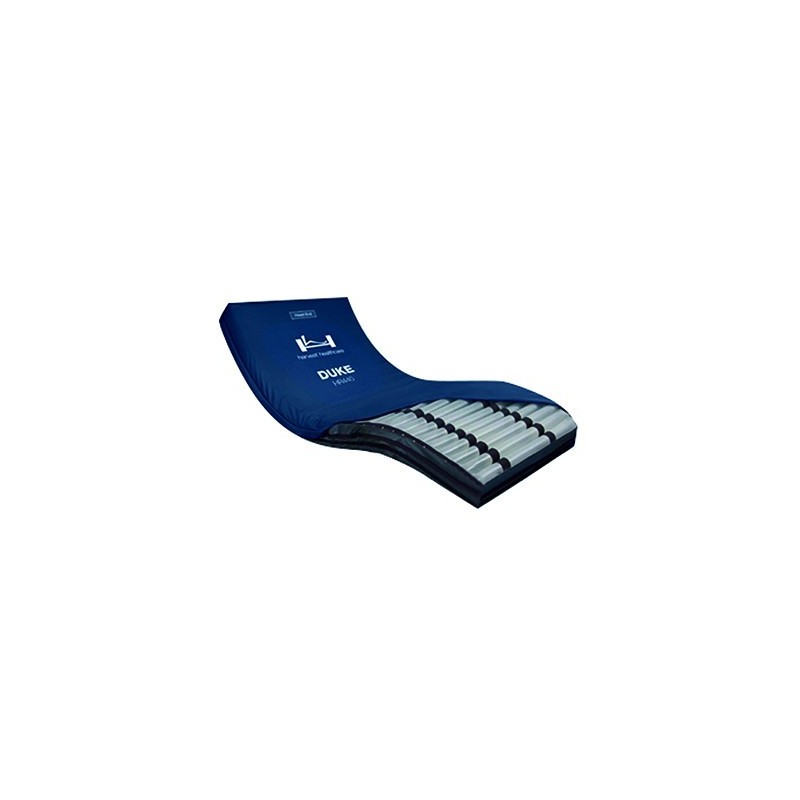


The Duke Active Mattress from Harvest Healthcare is a premium alternating pressure replacement mattress for residents assessed as very high risk of pressure ulceration, including those with existing stage 4 pressure injuries. The 30-cell system (25 alternating, 5 static pillow) on an integrated 50mm foam base delivers high-performance pressure offloading at 1980x900x140mm. The separable cover and cell assembly support full decontamination between residents. SWL is 247kg with the Harvest 3 pump. Complies with Bed Rail Regulations for Woburn, Woburn Low, Community, and Community Low frames. All cells interchangeable.
| Specification | Detail |
|---|---|
| Type | Alternating pressure replacement mattress |
| Air Cells | 25 alternating TPU cells + 5 static pillow cells (30 total) |
| Foam Base | Integrated 50mm foam layer |
| Dimensions | 1980 x 900 x 140mm |
| Weight | 9kg |
| Cover | 4-way stretch welded PU - VP, water resistant, Crib 5; separable for decontamination |
| Pump Compatibility | Harvest 250 (SWL 165kg / 26 stone); Harvest 3 (SWL 247kg / 39 stone) |
| Bed Rail Compliance | Woburn, Woburn Low, Community, Community Low bed frames |
| Reference | NCL-HR440 |
| Clinical Standard | NICE CG179 (very high risk and stage 4 pressure care) |
The Duke Active Mattress is a Class IIa active medical device under Medical Devices Regulation 2017/745. Clinical selection is restricted to residents assessed as very high risk under NICE CG179 or those with existing stage 3 or 4 pressure injuries where advanced alternating therapy is the appropriate intervention. SWL must be verified against the resident's documented weight with pump selection confirmed accordingly; MHOR 1992 documentation must record this verification before deployment. Bed rail compliance for Woburn, Woburn Low, Community, and Community Low frames must be confirmed against the specific bed frame in use. The Crib 5 cover meets BS 5852 institutional fire safety requirements. Separable decontamination of cover and cell assembly supports NHS IPC requirements between residents. Equipment register records must be maintained for CQC Regulation 12 readiness.
How does the Duke differ from the Sandringham, and what clinical factors determine which is prescribed?
The Sandringham and Duke are both replacement alternating pressure mattresses from Harvest Healthcare, but they are designed for different clinical risk levels. The Sandringham has 18 alternating cells and is indicated for high-risk residents per NICE CG179, including those at risk of Category 1 and 2 pressure injuries. The Duke has 25 alternating cells plus a 5-cell static pillow section and is indicated for very high-risk residents and for those with existing Category 3 or 4 pressure injuries where advanced alternating therapy is part of the wound management plan. The higher cell count in the Duke means each anatomical zone is offloaded more frequently within the alternating cycle, providing more intensive pressure redistribution. The Duke also carries a higher SWL ceiling of 247kg with the Harvest 3 pump, extending the range into heavier bariatric presentations. The prescribing clinician should use the NICE CG179 assessment alongside Waterlow or Braden scoring to determine which system matches the resident's current risk and wound status.
What does the bed rail compliance specification mean in practice, and why does it matter for mattress procurement?
Bed rail compliance refers to the MHRA bed safety guidance requirement that mattresses used in beds fitted with rails must not create unsafe gaps between the mattress edge and the rail that could result in limb or head entrapment. The mattress depth, edge stiffness, and surface profile all affect the gap geometry when the mattress is compressed against the rail during use. The Duke's compliance with Woburn, Woburn Low, Community, and Community Low bed frame regulations means that the mattress has been tested and confirmed not to create entrapment-risk gaps when fitted to those specific bed frames with their respective rail configurations. This compliance is a procurement requirement: deploying an alternating mattress in a bed frame for which entrapment compliance has not been confirmed is a patient safety risk and a regulatory non-compliance. Before deploying the Duke, the care setting must confirm that the bed frame in use is one of the four listed compatible types, or must conduct a separate entrapment risk assessment for the specific frame configuration.
