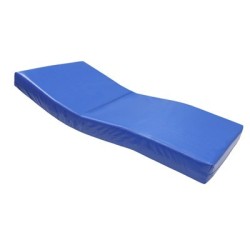


The Community Plus Static Mattress provides high-risk pressure redistribution using a higher-specification CMHR foam than the standard Community mattress, with a 190kg (30 stone) SWL. The four-way stretch vapour-permeable PU cover supports skin microclimate management and NHS IPC decontamination. Available in 900mm and 1200mm widths and in vandal-proof variants. Designed for profiling beds. Selected for residents assessed at high pressure risk per NICE CG179 who do not yet require an active alternating system.
| Specification | Detail |
|---|---|
| NCL-HSMCOMP | 2000 x 900 x 150mm - Standard |
| NCL-HSMCOMP.12 | 2000 x 1200 x 150mm - Wide (1200mm bed) |
| NCL-HSMCOMP.VP | Vandal-proof variants in both sizes |
| Foam Type | High-specification CMHR foam |
| Cover | 4-way stretch VP PU - water resistant |
| Safe Working Load | 190kg (30 stone) |
| Clinical Risk Level | High risk per NICE CG179 |
| Fire Standard | BS7177 (CMHR foam) |
| Bed Compatibility | Profiling beds |
The Community Plus is a Class I passive medical device under Medical Devices Regulation 2017/745. Clinical selection requires validated pressure risk assessment per NICE CG179 confirming high-risk status; for residents assessed at very high risk or those with existing pressure injuries above Category 1, an active alternating mattress must be prescribed. SWL must be verified against the resident's documented weight per MHOR 1992. CMHR foam meets the BS7177 institutional fire safety standard under the Regulatory Reform (Fire Safety) Order 2005. Equipment register documentation and MDR conformity records must be maintained for CQC Regulation 12 compliance. Clinical review must be scheduled at regular intervals to confirm the static mattress remains appropriate as the resident's risk profile evolves.
Is the Community Plus an appropriate long-term solution for a high-risk resident, or should an active mattress always be prescribed at high risk?
NICE CG179 does not mandate an active alternating mattress for all residents assessed as high risk; the guidance requires that the level of pressure care provided is matched to the individual's risk assessment, repositioning capacity, and care context. The Community Plus is clinically appropriate for a high-risk resident who can be repositioned manually at the intervals specified in the NICE CG179 protocol, where the care setting can deliver the required repositioning frequency consistently, and where no active pressure injury is present requiring treatment. An active alternating mattress becomes the appropriate prescription when manual repositioning at the required frequency cannot be achieved - due to staffing levels, the resident's pain or frailty, or the severity of their condition - or when a Category 2 or above pressure injury has developed and active offloading is required as part of the wound management plan. The Community Plus is therefore a clinically valid high-risk option within a documented care plan that specifies the repositioning frequency, skin surveillance schedule, and escalation criteria for moving to an active system.
How often should the Community Plus be replaced, and what signals indicate the mattress needs replacing?
CMHR foam loses its pressure redistribution performance over time through compression set, which is the permanent deformation of the foam caused by repeated loading cycles. The rate of compression set depends on the foam specification, the resident's weight, and the daily duration of use. The care setting should follow the manufacturer's guidance on replacement intervals, which typically range from 3 to 5 years depending on the foam grade and use pattern. Regardless of age, the mattress must be replaced when any of the following are observed: visible permanent indentation or uneven surface profile that does not recover after 30 minutes without a resident on the mattress; a bottom-out sensation where the resident's bony prominences can be felt through the mattress when pressing the surface with your hand; or any failure of the cover seams, tears in the cover surface, or evidence of fluid ingress into the foam core. Any mattress suspected of foam degradation must be removed from service immediately and the resident placed on a clinically appropriate alternative while a replacement is sourced.