
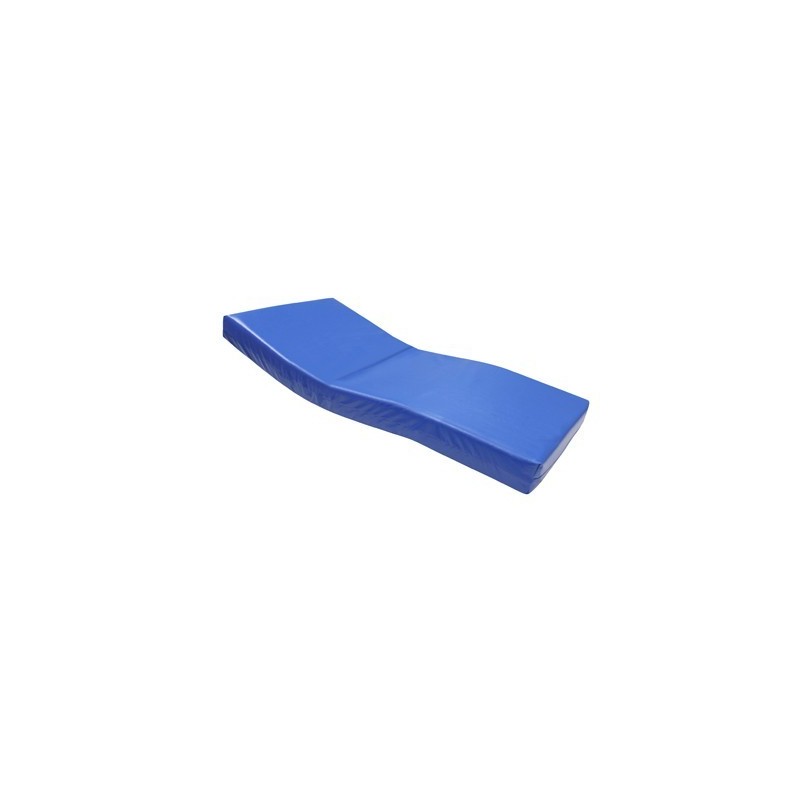

The Fire-Tech 7 Static Mattress provides high-risk pressure care for secure units, psychiatric inpatient settings, and other high-fire-risk environments where Crib 7 certification is required. The anti-ligature welded four-way stretch PU-coated cover eliminates accessible ligature points and provides NHS IPC wipe-clean and full-wash decontamination compliance. The antibacterial surface reduces microbial load between decontamination episodes. HR foam core. SWL 190kg. Available in 2000 x 900 x 150mm and 1900 x 900 x 150mm; weight 8.5kg.
| Specification | Detail |
|---|---|
| Fire Standard | Crib 7 (highest UK fire resistance certification) |
| Cover Type | Anti-ligature welded 4-way stretch VP PU - antibacterial, water resistant, fully washable |
| Foam Core | High-resilience foam |
| Dimensions | 2000 x 900 x 150mm or 1900 x 900 x 150mm |
| Safe Working Load | 190kg (30 stone) |
| Mattress Weight | 8.5kg |
| Indicated Settings | Secure units, psychiatric inpatient, high-dependency environments |
| Reference | NCL-HSMFIRET.VP |
| Clinical Risk Level | High risk per NICE CG179 |
The Fire-Tech 7 is a Class I passive medical device under Medical Devices Regulation 2017/745. The Crib 7 fire certification meets the fire safety specification required for secure, psychiatric, and high-dependency environments under the Regulatory Reform (Fire Safety) Order 2005 and Health Building Note guidance for mental health inpatient settings. The anti-ligature cover design must be confirmed as meeting the ligature risk assessment standard applicable to the specific secure setting before deployment; local estates and environmental safety leads must verify compliance with their ligature risk framework. SWL must be verified against the resident's documented weight per MHOR 1992. Equipment register records, ligature risk compliance documentation, and MDR conformity records must be maintained for CQC Regulation 12 compliance.
What is the difference between Crib 5 and Crib 7, and why does a psychiatric setting require Crib 7 rather than Crib 5?
Crib 5 (BS 5852) is the standard fire resistance certification required for institutional care settings including care homes, hospitals, and residential facilities. It requires the mattress to resist ignition from a specified standardised ignition source - a smouldering cigarette and a small flame - for a defined test period. Crib 7 represents a substantially more demanding fire resistance standard, requiring the mattress to resist ignition from a much larger flame source for a longer sustained period, simulating the conditions of a deliberate fire-setting incident. In psychiatric inpatient and secure settings, the assessed risk of deliberate fire-setting by residents means that Crib 5 alone is insufficient to meet the environment's fire safety specification; the Crib 7 standard is specifically adopted to address this elevated risk. Procuring a standard Crib 5 mattress for a setting that requires Crib 7 is a fire safety non-compliance and must be identified and rectified by the care setting's fire safety lead.
What does anti-ligature mean in practice for a mattress, and how should the cover be inspected?
A ligature is any point or feature on a surface or object that could be used to attach a cord, strap, or fabric and apply pressure to the neck or body. In a standard mattress, stitched seams, zip pull tabs, handles, and loose cover fixings can all represent ligature points. An anti-ligature mattress cover eliminates these features through design: stitched seams are replaced with heat-welded bonds with no exposed thread; no zip or accessible closing mechanism is present on the user-accessible cover surface; no handles, loops, or fixings protrude from the mattress surface. Care staff in the secure setting must inspect the anti-ligature cover at each cleaning episode to confirm that: no seam welds have separated or peeled; no cover damage has created accessible edges that could be rolled or twisted; and no attachments or repairs have been made to the cover surface that would reintroduce a ligature point. Any cover damage must be reported immediately and the mattress removed from service pending replacement, as a damaged anti-ligature cover provides no ligature risk assurance.
