
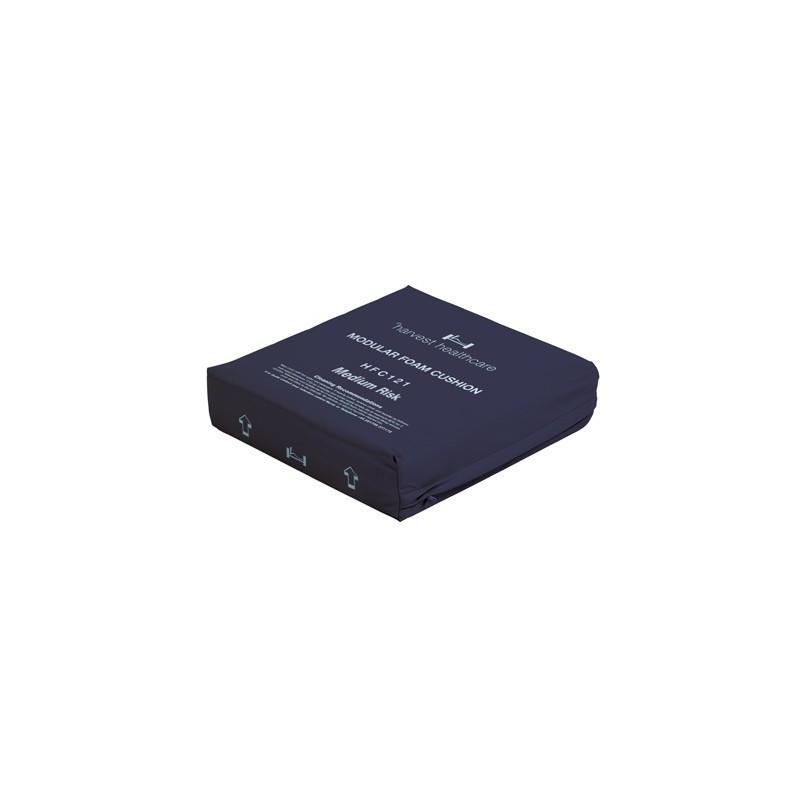


The Community Modular Foam Cushion provides medium-risk seating pressure redistribution using castellated block foam with integrated airflow channels. The four-way stretch zipped VP water-resistant cover is removable for decontamination; the non-slip base prevents cushion displacement during use. Designed to pair with the Community Static Mattress for 24-hour pressure area care across seated and lying positions. Available in two sizes: NCL-HFC121 (430 x 430 x 95mm, SWL 95kg) and NCL-HFC116 (500 x 500 x 95mm, SWL 108kg). Selected for medium-risk residents per NICE CG179.
| Specification | Detail |
|---|---|
| NCL-HFC121 | 430 x 430 x 95mm - SWL 95kg (15 stone) |
| NCL-HFC116 | 500 x 500 x 95mm - SWL 108kg (17 stone) |
| Foam Type | Castellated block foam |
| Cover | 4-way stretch zipped VP water-resistant |
| Base | Non-slip |
| Paired Mattress | Community Static Mattress (NCL-HSMCOM) |
| Clinical Risk Level | Medium risk per NICE CG179 |
The Community Modular Foam Cushion is a Class I passive medical device under Medical Devices Regulation 2017/745. Clinical selection requires validated pressure risk assessment per NICE CG179 confirming medium-risk status; for high or very high-risk residents, a higher-specification seating cushion must be prescribed. SWL must be verified against the resident's documented weight for the specific size selected; NCL-HFC121 must not be used for residents above 95kg and NCL-HFC116 must not be used for residents above 108kg. The cushion size must be matched to the seat pan dimensions of the chair or wheelchair to avoid overhang or poor contact coverage. Equipment register documentation and MDR conformity records must be maintained for CQC Regulation 12 compliance.
What is 24-hour pressure area care, and why is pairing a seating cushion with a mattress clinically important?
24-hour pressure area care refers to the principle that pressure redistribution must be maintained across all postures and surfaces that the resident occupies throughout the full day and night cycle, not only during the overnight bed period. NICE CG179 explicitly requires that pressure care assessment and intervention covers all positions including lying and sitting, recognising that a resident who spends six hours per day seated in a chair is at significant risk of pressure injury at the seated contact sites - primarily the ischial tuberosities and posterior sacrum - regardless of the quality of their overnight mattress. Pairing the Community Modular Foam Cushion with the Community Static Mattress creates a matched system where the medium-risk pressure redistribution specification is consistent across both the seated and lying positions, avoiding the clinical gap that arises when a resident has a well-specified mattress but sits on an unpadded standard chair seat for extended periods. The care plan must document the complete pressure care system including both the mattress and the seating cushion, with reassessment of both components when the resident's risk level changes.
How should the correct cushion size be selected between NCL-HFC121 and NCL-HFC116?
Size selection for a seating cushion involves two independent factors that must both be satisfied: the resident's weight versus the SWL, and the seat pan dimensions versus the cushion footprint. For SWL: the resident's documented weight must not exceed 95kg for NCL-HFC121 or 108kg for NCL-HFC116; a resident above 95kg requires the larger variant. For seat pan fit: the cushion footprint should match or be slightly smaller than the seat pan of the chair or wheelchair - a cushion significantly smaller than the seat pan leaves the edges of the seat pan uncushioned and creates pressure points at the exposed foam edges where the thigh contacts the seat frame; a cushion significantly wider than the seat pan overhangs the armrests and may impair lateral transfer safety. The occupational therapist should measure the seat pan width and depth of the intended chair before prescribing and confirm that the selected size provides adequate coverage without significant overhang. Where the resident's weight is above 95kg but below 108kg, the NCL-HFC116 at 500 x 500mm may be appropriate on both SWL and size grounds, but the seat pan dimensions must confirm the larger footprint fits without overhang before it is issued.