
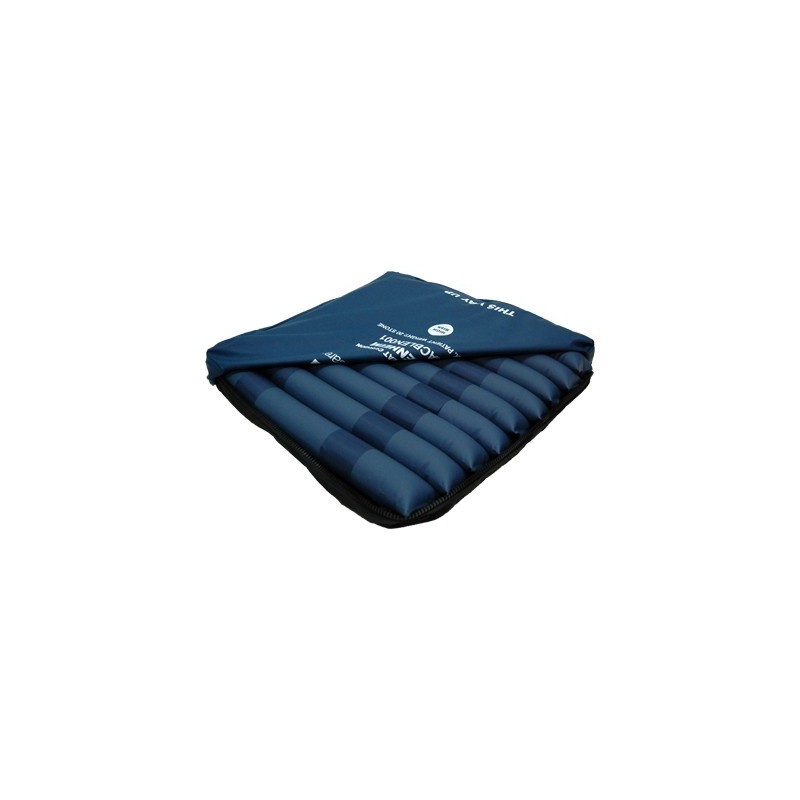

The Blenheim Active Seat Cushion delivers dynamic alternating pressure redistribution through 9 air cells during seated use, extending active pressure care into the seated position for very high-risk residents. Compatible with the Harvest 250 pump. Available as cushion only (NCL-HACBLEN001), cushion for Harvest 250 (NCL-HACBLEN001.P250), or complete system with pump (NCL-HACBLEN001.HPU250). SWL 152kg. 460 x 460 x 60mm. Pairs with Balmoral II mattress for 24-hour care. MDR 2017/745 Class IIa active medical device.
| Specification | Detail |
|---|---|
| Active Cells | 9 alternating air cells |
| Dimensions | 460 x 460 x 60mm |
| Safe Working Load | 152kg (24 stone) |
| Cover | 4-way stretch welded water-resistant |
| Base | Non-slip |
| NCL-HACBLEN001 | Cushion only |
| NCL-HACBLEN001.P250 | Cushion configured for Harvest 250 pump |
| NCL-HACBLEN001.HPU250 | Complete system with Harvest 250 pump |
| Pump Compatibility | Harvest 250 |
| Paired Mattress | Balmoral II (NCL-HAMBALM003) |
| Clinical Risk Level | Very high risk per NICE CG179 |
| Regulatory Status | MDR 2017/745 Class IIa active medical device |
The Blenheim Active Seat Cushion is a Class IIa active medical device under MDR 2017/745. Clinical selection requires occupational therapist assessment confirming very high-risk seating need per NICE CG179. SWL must be verified per MHOR 1992. The pump must be confirmed operational before clinical issue; the cushion provides no therapeutic benefit when disconnected from the pump. The Harvest 250 pump must be secured safely adjacent to the seating position with tubing managed to prevent trip hazards. Equipment register records including pump and cushion serial numbers and MDR conformity documentation must be maintained for CQC Regulation 12 compliance.
When is an active alternating seat cushion indicated rather than a high-specification static seating cushion?
An active alternating seat cushion is indicated when the resident's very high pressure risk in the seated position cannot be adequately managed by a static seating cushion, regardless of specification. The clinical equivalence point between static and active seating pressure management is assessed by the occupational therapist using the NICE CG179 framework: where a resident has existing pressure injuries at seated contact sites (ischial tuberosities, sacrum) that are not healing despite static cushion use, or where the risk assessment indicates that static redistribution alone is clinically insufficient, active alternating seating therapy provides the dynamic offloading required. The Blenheim is also indicated for residents who spend the majority of their day seated rather than in bed, where their active mattress is not providing pressure care during the seated period; in this scenario, the total time on active therapy is insufficient if the cushion is static, and the active seat cushion extends the therapeutic coverage into the seated period.
Can the Blenheim cushion be used with any pump, or does it require specifically the Harvest 250?
The Blenheim Active Seat Cushion is engineered and validated for use with the Harvest 250 pump only. The pump determines the airflow rate, cycle timing, and pressure range delivered to the cushion cells; using an incompatible pump risks under-inflation (reduced therapeutic benefit) or over-inflation (discomfort and potential cell damage) of the 9-cell array. The Harvest 250 provides the correct flow characteristics and pressure settings for the Blenheim's cell configuration. The NCL-HACBLEN001 cushion-only variant is intended for care settings that already have a Harvest 250 pump available for connection; it is not compatible with the Harvest 1 or Harvest 3 pumps. The NCL-HACBLEN001.HPU250 complete system option ensures pump and cushion compatibility by supplying them as a matched pair. The pump-to-cushion pairing must be documented in the equipment register and must not be changed without clinical reassessment.
