
Blood Pressure Monitors
Blood pressure monitors in validated automatic upper arm and wrist formats for hypertension monitoring and NEWS2 vital signs assessment in care homes and NHS settings, BHS-validated for clinical accuracy and MHRA registered.
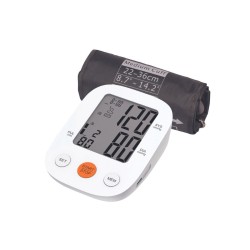
Blood Pressure Monitors for Clinical Hypertension Monitoring and NEWS2 Assessment
Clinical Summary: Accurate blood pressure monitoring is a fundamental clinical requirement in care homes and NHS settings for hypertension management, medication review, NEWS2 vital signs assessment, and deterioration detection. Only blood pressure monitors validated by the British Hypertension Society (BHS) or the European Society of Hypertension (ESH) should be used for clinical decision-making, as unvalidated devices may produce inaccurate readings that compromise patient safety under NICE CG127 hypertension management guidance.
Blood Pressure Monitor Types
- Validated Automatic Upper Arm Monitors: Oscillometric upper arm monitors with BHS or ESH validation for clinical accuracy, providing systolic and diastolic pressure and pulse rate readings with large digital displays suited to care home use by non-specialist staff. Upper arm format is recommended over wrist by BHS guidance for most clinical applications.
- Validated Wrist Monitors: Compact wrist blood pressure monitors for patients where upper arm measurement is not possible due to arm size, mobility, or lymphoedema, used with wrist at heart level to minimise positional error during measurement.
- Memory and Bluetooth Monitors: Monitors with reading memory storage and Bluetooth or USB connectivity for download of measurement history into electronic care records, supporting medication review documentation and remote clinical monitoring programmes.
- Large Cuff and Bariatric Monitors: Upper arm monitors with extended large cuff sizes for patients with larger upper arm circumferences where standard cuffs would produce inaccurate readings due to under-cuffing, an important clinical accuracy consideration in bariatric care settings.
Clinical Compliance and Validation Standards
Blood pressure monitors supplied by Care Supplies carry MHRA registration and BHS or ESH clinical validation where specified, confirming accuracy to within 5mmHg mean difference from reference sphygmomanometer measurement. NICE CG127 and NICE NG136 hypertension guidelines recommend that only clinically validated devices are used for blood pressure measurement in clinical settings. Cuff size selection is critical for measurement accuracy — under-cuffing produces falsely elevated readings and over-cuffing produces falsely low readings. Care homes should stock the correct cuff size range to accommodate all resident arm circumferences, with large and bariatric cuffs available alongside the standard cuff provided with the monitor.
| Monitor Type | Clinical Validation | Primary Application | Key Standard |
|---|---|---|---|
| Upper Arm Automatic | BHS or ESH validated | Routine clinical monitoring, NEWS2 | NICE CG127 / NICE NG136 |
| Wrist Monitor | BHS or ESH validated | Where upper arm not possible | NICE CG127 |
| Bluetooth Memory | BHS or ESH validated | EPR integration, remote monitoring | NICE NG136 / MHRA |
| Bariatric Large Cuff | BHS or ESH validated | Larger arm circumferences | NICE CG127 / MHRA |
Frequently Asked Questions
Q: Why is BHS validation important for care home blood pressure monitors?
A: BHS validation confirms that a blood pressure monitor has been independently tested against a reference standard and consistently measures blood pressure within 5mmHg of the true value. Unvalidated monitors may produce systematically inaccurate readings, leading to incorrect clinical decisions about hypertension treatment, medication dosing, and clinical escalation. NICE CG127 specifically recommends using only validated devices for clinical blood pressure measurement.
Q: What cuff size should be used for blood pressure monitoring in care homes?
A: Cuff size must match the patient upper arm circumference. A cuff that is too small for the arm produces falsely elevated readings, and a cuff too large produces falsely low readings. Standard adult cuffs fit arm circumferences of 22 to 32cm. Large adult cuffs are required for 33 to 42cm, and bariatric cuffs for above 42cm. Care homes should measure resident arm circumference at the first blood pressure assessment and document the correct cuff size in the care plan for consistent accurate monitoring.