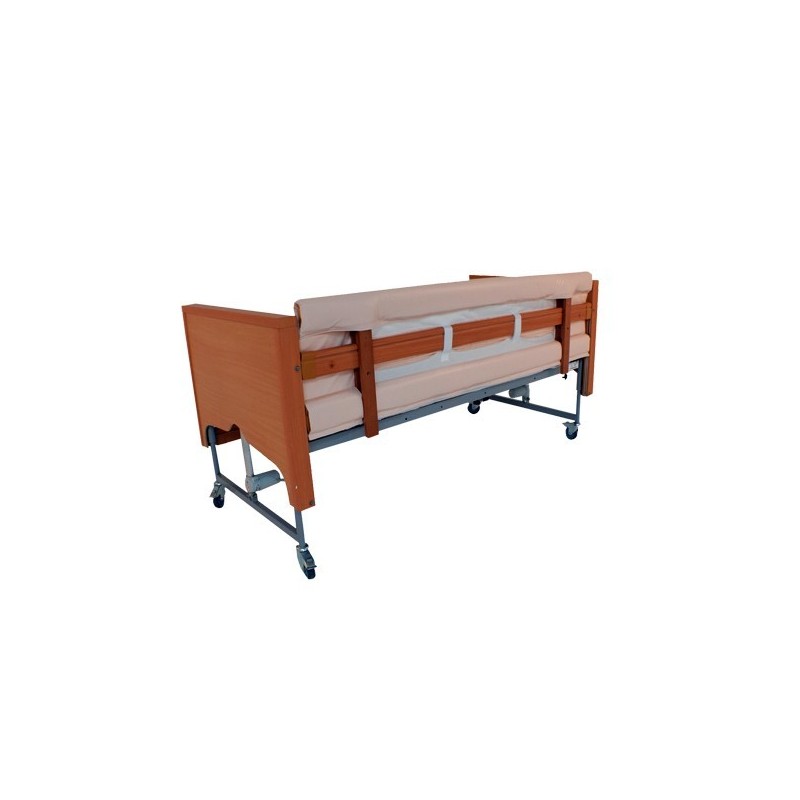


The Three-Rail Bumper with Net Window (200cm) is designed for profiling beds with a third rail extension, providing padded protection at the additional rail level above the standard two-rail configuration. A breathable net window connects all three padded sections, maintaining carer visibility and reducing entrapment risk. Wipe-clean outer; hook and loop fastenings; supplied in pairs. Available in 220cm (NCL-CASA3R22) for longer three-rail configurations.
| Specification | Detail |
|---|---|
| Reference | NCL-CASA3R |
| Length | 200 cm |
| Configuration | Three-rail; third rail extension padded section |
| Net Window | Breathable; concertina |
| Outer Material | Wipe-clean |
| Fastening | Hook and loop |
| Supplied | In pairs |
| Extended Length | NCL-CASA3R22 (220cm) |
Profiling beds with three-rail configurations create additional impact and entrapment zones at the third rail that standard two-rail bumpers do not cover; the three-rail bumper addresses these additional risk zones per MHRA bed rail safety guidance on full-length, full-height coverage. CQC Regulation 12 (safe care) requires that bed safety equipment is appropriate for the specific bed configuration in use; specifying a two-rail bumper for a three-rail bed would leave the third rail unprotected, which is not compliant with MHRA guidance. A documented bed rail risk assessment confirming the three-rail configuration, the clinical indication, and the Mental Capacity Act 2005 best interest assessment is required before fitting.
What is a three-rail bed configuration and when is it used?
A three-rail configuration adds a third rail section above the standard two-rail system, increasing the overall height of the bed rail structure. Three-rail systems are typically used for residents who require a higher rail height for increased safety - for example, where the standard two-rail configuration does not provide sufficient height to prevent the resident from rolling over the top rail, or where the bed is used at a height that makes a third rail clinically indicated in the bed rail risk assessment. The clinical team and occupational therapist should determine whether a three-rail configuration is appropriate for the individual resident's needs and risk profile.
Can a standard two-rail bumper be used on a three-rail bed?
No. A standard two-rail bumper cannot be fitted to a three-rail configuration without leaving the third rail unprotected. MHRA guidance on bed rail safety requires that all rail sections accessible to the resident are covered or protected to prevent impact injury and entrapment; leaving the third rail bare while covering the lower two rails would create an unprotected impact and entrapment zone at the highest rail position - the position most likely to be contacted by the resident's head and shoulders. The three-rail bumper (NCL-CASA3R or NCL-CASA3R22) must be specified for beds with a third rail extension.