
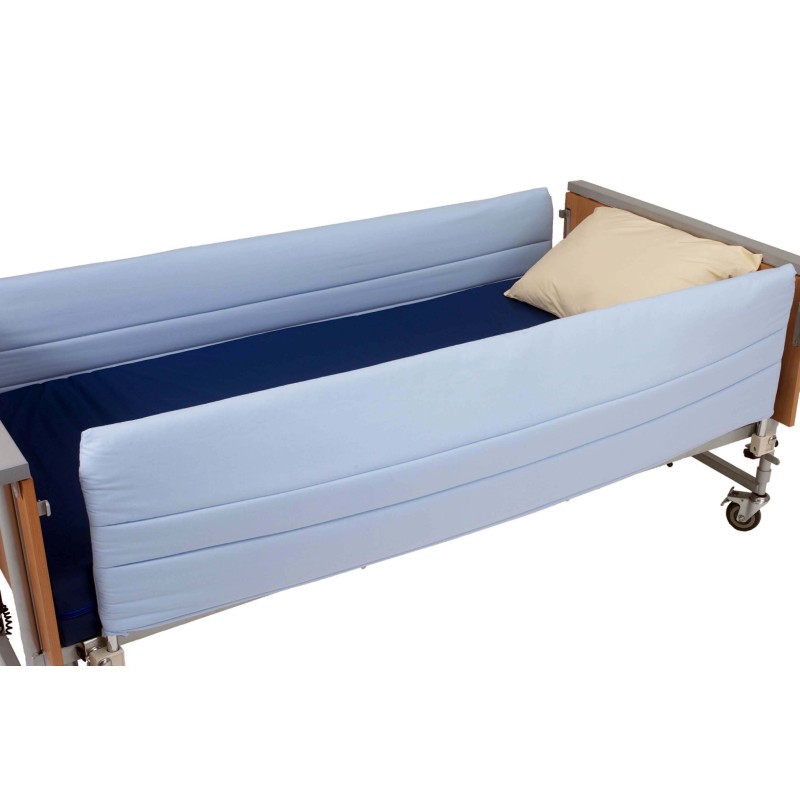

The Quilted Cotside Bumper with Tucks (200cm, Open Ends) provides full profiling bed length tuck-anchored sub-rail entrapment protection with an open-end design for ventilation. Hollow fibre filled; FR polyester outer; machine washable; light blue. Closed-end alternatives in shorter lengths: NCL-CSS (134cm) and NCL-CSL (183cm).
| Specification | Detail |
|---|---|
| Reference | NCL-CS200OE |
| Length | 200 cm |
| Ends | Open |
| Filling | Hollow fibre |
| Outer | Fire-retardant polyester |
| Securing Method | Extra-long tucks under mattress |
| Washing | Machine washable |
| Colour | Light blue |
| Closed-End Versions | NCL-CSS (134cm); NCL-CSL (183cm) |
The 200cm tuck bumper provides full-length sub-rail entrapment prevention through the mattress-anchored tuck mechanism, consistent with MHRA guidance on sub-rail entrapment risk management. FR polyester meets the Regulatory Reform (Fire Safety) Order 2005 fire safety requirement. Machine washability provides HTM 01-04-compliant decontamination. CQC Regulation 12 (safe care) documentation should confirm the sub-rail entrapment risk, the full-length tuck specification rationale, and the laundering schedule. Mental Capacity Act 2005 best interest obligations apply. The open-end design is appropriate where lateral end protection at the rail end positions is not identified as a specific risk in the bed rail risk assessment.
When should the 200cm open-end version be chosen over the closed-end shorter versions?
The 200cm open-end version (NCL-CS200OE) is the appropriate specification where full-length rail coverage is required and lateral end protection at the bumper corners is not a specific clinical need. The shorter closed-end versions (NCL-CSS at 134cm, NCL-CSL at 183cm) should be specified where shorter rail coverage is required or where the individual risk assessment identifies the bumper end positions as an impact risk for the resident. If full-length coverage with closed-end lateral protection is clinically indicated, the bed rail risk assessment findings should guide whether the 200cm open-end version with additional supplementary corner protection or a different bumper specification is appropriate.
How does fitting the 200cm tuck bumper differ from shorter tuck bumper versions?
The fitting process is the same for all tuck bumper lengths: the bumper is positioned against the bed rail, and the extra-long tuck extensions are fed beneath the mattress edge along the length of the bumper body. For the 200cm version, the tuck sections run the full standard profiling bed length; care should be taken to feed the tucks evenly along the entire length before the mattress is repositioned, ensuring the tucks lie flat and are not bunched or folded. After repositioning the mattress, confirm the tucks are held in position and the bumper body sits correctly against the rail surface before the bed is returned to use.
