
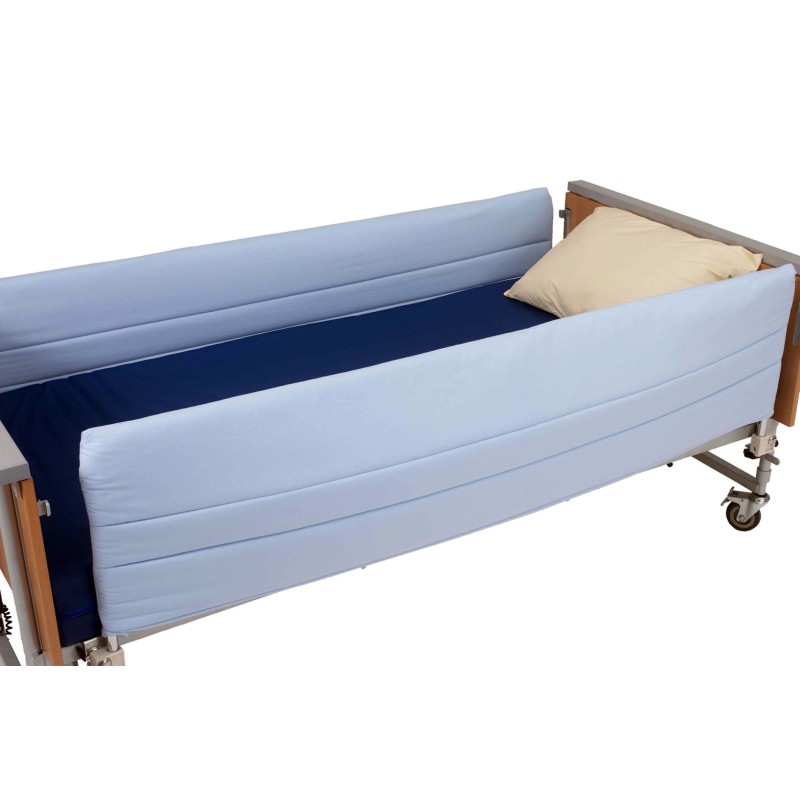

The Quilted Cotside Bumper with Tucks (183cm, Closed Ends) provides extended-length padded coverage with closed ends and sub-rail entrapment prevention through fabric tucks secured under the mattress. Hollow fibre filled; FR polyester outer; machine washable; light blue. The 134cm closed-end version is NCL-CSS; the 200cm open-end version is NCL-CS200OE.
| Specification | Detail |
|---|---|
| Reference | NCL-CSL |
| Length | 183 cm |
| Ends | Closed |
| Filling | Hollow fibre |
| Outer | Fire-retardant polyester |
| Securing Method | Extra-long tucks under mattress |
| Washing | Machine washable |
| Colour | Light blue |
| Other Versions | NCL-CSS (134cm closed ends); NCL-CS200OE (200cm open ends) |
The same MHRA sub-rail entrapment prevention rationale, Regulatory Reform (Fire Safety) Order 2005 FR requirement, HTM 01-04 machine-washable decontamination standard, CQC Regulation 12 equipment documentation obligations, and Mental Capacity Act 2005 best interest obligations that apply to the 134cm version (NCL-CSS) apply equally to the 183cm version. The 183cm body length and closed-end specification should each be confirmed as clinically indicated in the individual bed rail risk assessment before procurement.
When should the 183cm version be specified rather than the 134cm?
The 183cm version (NCL-CSL) should be specified where the clinical assessment indicates that 134cm of padded coverage does not cover the rail section accessible to the resident during sleep, or where the resident's movement extends beyond the 134cm bumper body and would leave unprotected rail beyond the bumper end. Both versions use the same tuck mechanism, hollow fibre filling, closed-end design, and machine-washable FR polyester specification; the selection is based solely on the padded coverage length requirement confirmed in the bed rail risk assessment.
Are the tucks MHRA compliant for sub-rail entrapment prevention?
The tuck mechanism addresses the MHRA-identified sub-rail entrapment zone through a mattress-anchored barrier that prevents limbs from passing beneath the mattress edge into the sub-rail zone. MHRA guidance does not prescribe a specific mechanism for sub-rail entrapment prevention, but requires that identified entrapment zones are addressed with appropriate safety measures. The mattress-anchored tuck approach satisfies this requirement for the side-rail sub-mattress entrapment zone. The bed rail risk assessment should document the sub-rail entrapment risk and confirm the tuck mechanism as the selected control measure, consistent with the care home's overall MHRA-compliant bed safety programme.
