
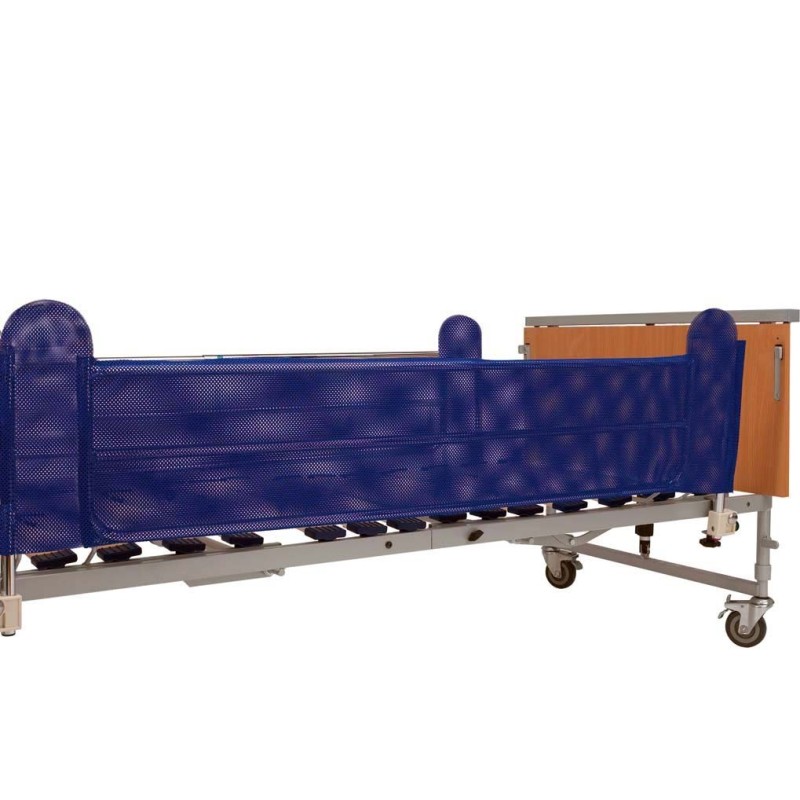

The Net Rail Cover (183cm, 3-Rail, Closed Ends) provides extended-length net barrier coverage for profiling beds with longer telescopic three-section side rail configurations. Same tea-cosy fitting method and closed-end design as the 134cm version (NCL-NET). Breathable tough net maintains visibility. The flat-topped rail version is NCL-NETPB (200cm, open ends).
| Specification | Detail |
|---|---|
| Reference | NCL-NETL |
| Length | 183 cm |
| Rail Model | 3-rail; for telescopic side rails |
| Ends | Closed |
| Material | Breathable tough net |
| Fitting Method | Tea-cosy style over the rail |
| Shorter Version | NCL-NET (134cm, closed ends) |
| Flat-Top Version | NCL-NETPB (200cm, open ends) |
The same MHRA gap entrapment zone coverage rationale, CQC Regulation 12 documentation requirements, and Mental Capacity Act 2005 best interest obligations applicable to the 134cm version (NCL-NET) apply to the 183cm version. The 183cm length must be confirmed as appropriate for the specific telescopic rail length in use; the rail length should be measured and documented in the care home equipment register before procurement. Confirm the tea-cosy fit adequately covers the full telescopic rail profile for the specific bed model before the bed is returned to clinical use.
When should the 183cm version be chosen rather than the 134cm?
The 183cm version (NCL-NETL) should be specified where the telescopic rail length is greater than 134cm, or where the 134cm net cover does not extend across the full accessible rail profile from end to end. The net cover must cover the complete telescopic rail length to prevent limb access to any uncovered section of the rail mechanism. Measure the telescopic rail length in its standard clinical position (partially or fully extended as used for the individual patient) before procurement, and confirm the 183cm version covers the measured length with adequate coverage at both ends.
How does the tea-cosy fitting method work in practice?
The tea-cosy fitting method positions the net cover over the top of the bed rail, with the net draping down on both the inner (resident-facing) and outer faces of the rail; the closed bottom edge sits beneath the lower rail section, holding the cover in position by the downward drape on both sides and the closed lower edge. The cover is removed and replaced without unfastening any fixings, by lifting it over the top of the rail in the same way a tea cosy is placed over and removed from a teapot. This fitting method suits the telescopic rail profile because it accommodates the variable geometry of the telescoping mechanism without requiring attachment points on the rail surface itself.
