
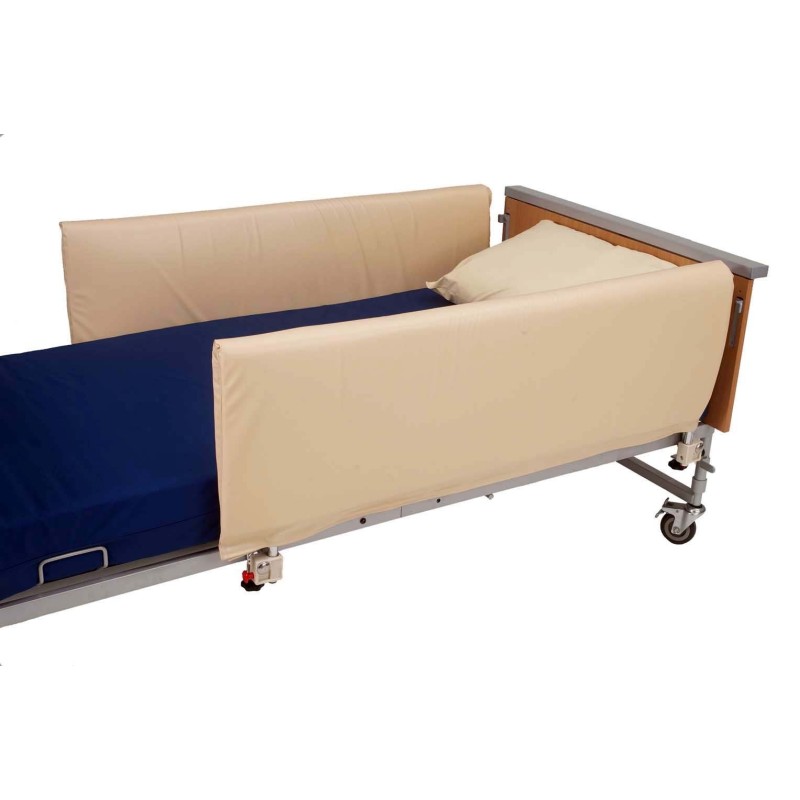


The High-Sided Cotside Bumper (134x96cm, Closed Ends) provides the same 96cm high-sided FR foam padded rail protection as the open-ended version (NCL-CSBH) with the addition of closed ends that cushion the rail end positions for more active patients who contact the bumper corners during sleep movement. Wipe-clean cover; hook and loop fastenings. Extended closed-end version is NCL-CSBHLE (183x96cm); open-end version is NCL-CSBH (134x96cm).
| Specification | Detail |
|---|---|
| Reference | NCL-CSBHE |
| Dimensions | 134 x 96 cm (53" x 38") |
| Ends | Closed (padded end cushioning) |
| Foam | Fire-retardant (FR) |
| Cover | Wipe-clean |
| Fastening | Hook and loop |
| Open End Version | NCL-CSBH (134 x 96 cm open ends) |
| Extended Closed End | NCL-CSBHLE (183 x 96 cm closed ends) |
MHRA guidance on bed rail safety requires that all accessible rail surfaces, including rail end positions, are protected where the risk assessment identifies an impact risk at those points. For more active patients whose movement during sleep brings them into contact with the rail ends, closed-end bumpers directly address this risk. CQC Regulation 12 (safe care) documentation should confirm the clinical rationale for specifying closed rather than open ends, with reference to the individual resident's movement patterns and the bed rail risk assessment findings. The 96cm height requirement and FR foam fire safety compliance requirements are the same as for the open-ended version.
When should closed ends be specified rather than open ends?
Closed ends (NCL-CSBHE or NCL-CSBHLE) should be specified where the bed rail risk assessment identifies a risk of impact at the rail end positions due to the individual resident's movement patterns during sleep or periods of agitation. More active patients who move extensively during the night, or residents with conditions causing involuntary movement, may contact the bumper end positions in a way that open-ended bumpers do not protect against. Where the primary risk is impact along the rail surface rather than at the rail ends, open-ended bumpers (NCL-CSBH or NCL-CSBHL) are appropriate and provide adequate protection at lower specification cost.
Do closed ends affect the bumper fitting or the hook and loop fastening?
No. The closed-end construction adds padded cushioning at the bumper end positions but does not change the hook and loop fastening mechanism or the 134x96cm body dimensions that fit the rail. The bumper is fitted in the same manner as the open-ended version; the closed ends simply provide padded coverage at the corners where open-ended bumpers have an uncovered rail end position. Care staff should confirm that the closed ends are positioned correctly against the rail end stops during initial fitting and at subsequent inspections.