
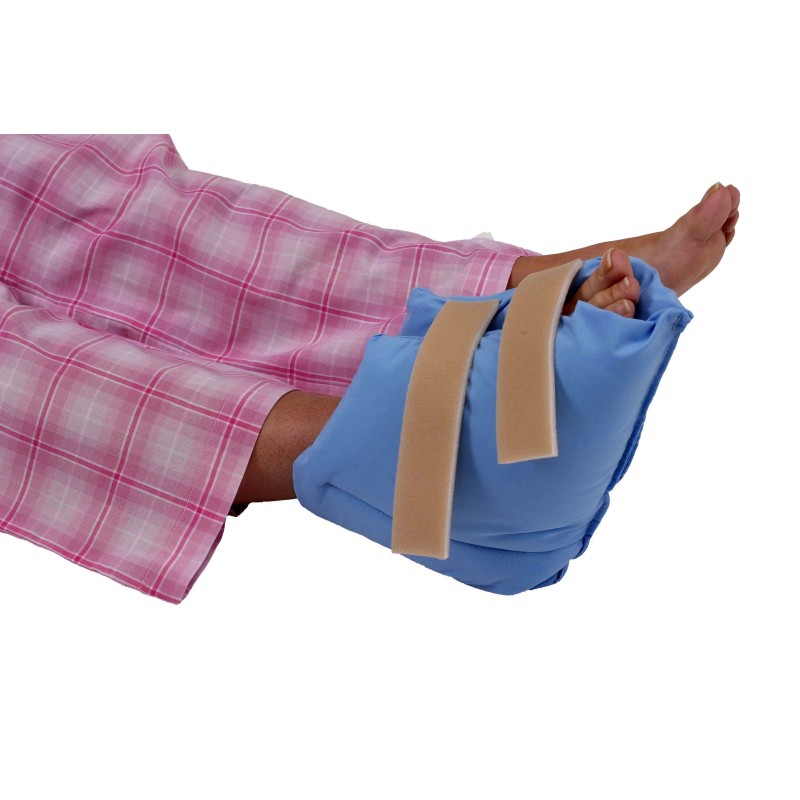

The Fibre Filled Heel Protectors are designed for patients with drop foot and ankle malposition, providing hollow fibre cushioning and a high-sided bootee design that prevents ankle knocking and medial malleolus skin damage. The inherently flame-retardant outer material meets fire safety requirements for care home use, with foam-covered straps preventing strap pressure on the limb. Universal one-size design with hook-and-loop fastening suits all resident foot sizes.
| Specification | Detail |
|---|---|
| Reference | NCL-FFHC |
| Inner Material | Hollow fibre |
| Outer Material | Inherently flame-retardant |
| Design | High-sided bootee |
| Straps | Foam-covered, secure fit |
| Fit | Universal (one size) |
| Fastening | Hook-and-loop |
NICE CG179 identifies ankle and lower limb bony prominences as pressure ulcer risk sites requiring protection for patients with limited mobility. The high-sided bootee design addresses both heel pressure and medial malleolus ankle knocking risk, which is particularly prevalent in patients with drop foot or lower limb spasticity. The inherently FR outer material meets the Regulatory Reform (Fire Safety) Order 2005 requirements for patient bedding and positioning aids used in care home settings. CQC Regulation 12 (safe care) documentation should include the protectors in the tissue viability and positioning care plan, with the clinical rationale for selection over standard heel-only protectors recorded where the patient has drop foot or ankle malposition.
How do these protectors differ from standard heel protectors for drop foot patients?
Standard heel protectors focus on pressure redistribution at the posterior heel and Achilles tendon. The Fibre Filled Heel Protectors additionally provide a high-sided bootee structure that prevents lateral ankle knocking - a specific complication of drop foot and lower limb muscle weakness where the feet fall outward and the medial malleoli contact each other during bed rest. Where the clinical assessment identifies ankle knocking as a risk alongside heel pressure, the high-sided bootee design addresses both concerns in a single product. For patients without ankle malposition risk, a standard heel protector or a floating heel device such as the Thorpe Mill Leg Trough may be more appropriate.
What does inherently flame-retardant mean for the washing performance?
Inherently FR means the flame-retardant property is built into the chemical structure of the fibre itself, rather than applied as a surface coating or treatment. This means the FR performance is maintained across repeated washing cycles throughout the product's lifespan, unlike surface-treated FR materials where the flame-retardant coating may degrade with washing. For care home procurement officers, inherently FR materials offer a more reliable long-term fire safety specification under the Regulatory Reform (Fire Safety) Order 2005 for patient bedding and positioning aids.