
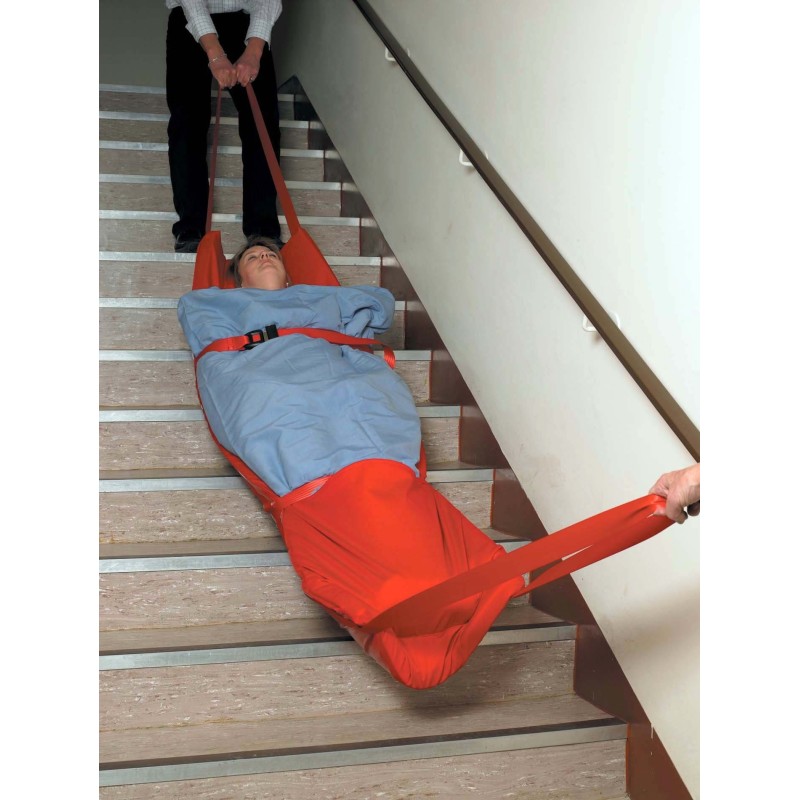

The Evacuation Sledge (NCL-EVSG) is a fire evacuation aid for the safe transfer of immobile residents via stairs and floor surfaces. Dual-layer foam (firm base, soft top); safety belts; foot pocket; pulling loops; head-end control loop. Stored in an included wall-mounted pouch. Regulatory Reform (Fire Safety) Order 2005 PEEP provision.
| Specification | Detail |
|---|---|
| Reference | NCL-EVSG |
| Construction | Dual-layer foam; coated low-friction underside |
| Patient Security | Safety belts; foot pocket; head-end control loop |
| Operators | One or two persons |
| Storage | Wall-mountable pouch (included) |
| Surfaces | Stairs; carpets; concrete; all floor types |
The Regulatory Reform (Fire Safety) Order 2005 requires the Responsible Person in a care home to assess fire risk and maintain evacuation plans for all occupants, including Personal Emergency Evacuation Plans for residents with mobility impairments who cannot self-evacuate via stairs. The evacuation sledge is an approved equipment provision for this requirement. CQC Regulation 12 (safe care) requires that evacuation equipment is maintained, accessible, and that staff are trained in its use; regular fire drills should include practice with the evacuation sledge to ensure staff competence before an emergency occurs.
How does the evacuation sledge work on stairs?
The sledge's firm base layer and coated low-friction underside allow it to slide down stairs in a controlled manner, guided by the operator holding the head-end control loop. The operator descends the stairs in front of the sledge, controlling the speed of descent with the loop, while a second operator at the foot end provides additional braking and directional control if needed. The patient's weight is distributed along the full length of the sledge, preventing pitching or tipping on the stair angle. The safety belts and foot pocket keep the patient secure throughout the descent. The design allows one-person operation for able operators, with two people recommended for heavier patients or steep stairways.
What training is required before evacuation sledge use?
The Regulatory Reform (Fire Safety) Order 2005 requires that staff who may need to use evacuation equipment are trained in its use before an emergency occurs. Training should cover: correct patient placement and securing with the safety belts and foot pocket; single and two-person stair descent technique; how to negotiate door frames and narrow spaces; how to operate on different floor surfaces including carpet and stairs; and the care home's specific evacuation routes and assembly points. Training should be documented, refreshed annually or when new staff join, and tested in realistic fire drill scenarios. Untrained staff should not attempt to use the sledge without prior instruction.