
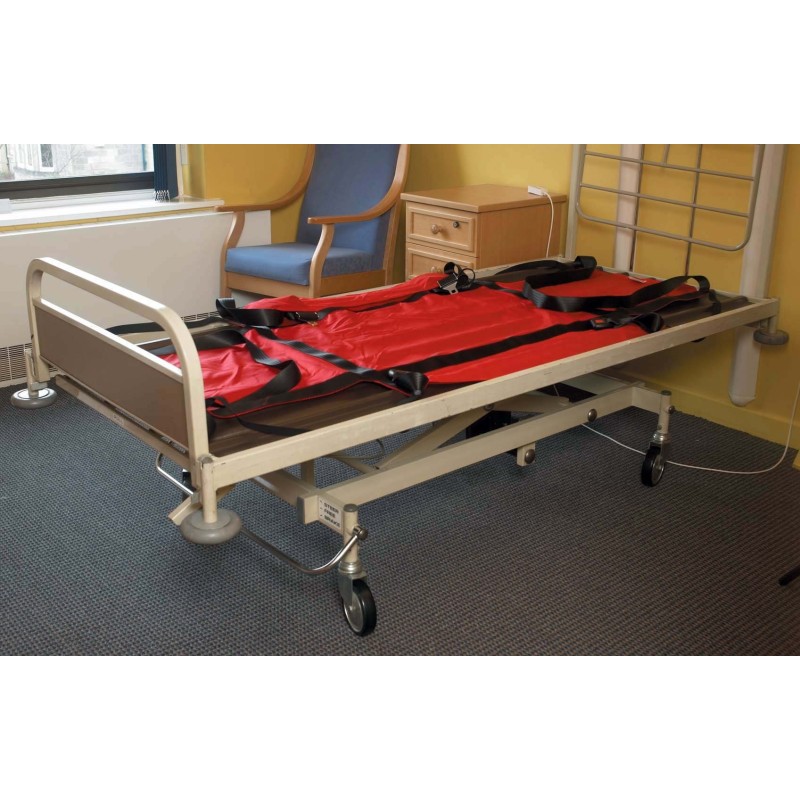


The Evacuation Sheet (NCL-EVS) fits permanently beneath the standard mattress using elasticated fixings; in an emergency, the patient is evacuated on the mattress without transfer. Safety belts; head and foot pull straps; head-end control strap; slippery underside; strap pockets. Two trained operators required. Regulatory Reform (Fire Safety) Order 2005 PEEP provision.
| Specification | Detail |
|---|---|
| Reference | NCL-EVS |
| Fitting | Elasticated fixings beneath standard mattress |
| Patient Security | Safety belts; foot securing; strap pockets |
| Operator Controls | Head and foot pull straps; head-end holding strap |
| Underside | Slippery coated - stairs, carpets, all surfaces |
| Operators | Two trained persons |
| Wider Mattress Version | NCL-EVS-120 (for 120cm wide mattresses) |
The Regulatory Reform (Fire Safety) Order 2005 requires PEEPs for residents unable to self-evacuate; the NCL-EVS provides the equipment component of the PEEP for residents on standard mattresses. CQC Regulation 12 (safe care) requires that evacuation equipment is maintained, accessible, and that staff are trained before emergencies occur. The mattress evacuation approach eliminates the patient transfer step required by standalone evacuation sledges, reducing evacuation time and manual handling risk. Fire drill practice should test the full evacuation sequence including mattress extraction from the bed.
How does the NCL-EVS differ from the NCL-EVO evacuation overlay?
The NCL-EVO is a 90mm anti-pressure foam overlay that sits on top of the mattress and provides daily pressure care benefits while remaining ready for evacuation; it includes integrated tucks that secure to the bed and cocoon the patient during evacuation, and its PVC underside slides across surfaces. The NCL-EVS is a sheet fitted beneath the existing standard mattress using elasticated fixings; it does not alter the sleep surface or provide pressure care benefits, but converts any existing standard mattress into an evacuation-capable system. The NCL-EVS is appropriate where the resident uses a standard mattress and does not require a pressure overlay; the NCL-EVO is appropriate where a pressure overlay is clinically indicated.
How should the elasticated fixings be inspected and maintained?
The elasticated fixings should be inspected at each mattress change and during routine CQC Regulation 12 equipment checks to confirm they are undamaged, that the elastic has retained its tension, and that the sheet is positioned correctly beneath the mattress without bunching. Degraded elastic that no longer holds the sheet firmly against the mattress base may allow the sheet to shift during use, potentially compromising its positioning for rapid deployment in an emergency. Any sheet with damaged fixings should be replaced before the bed is returned to use.