
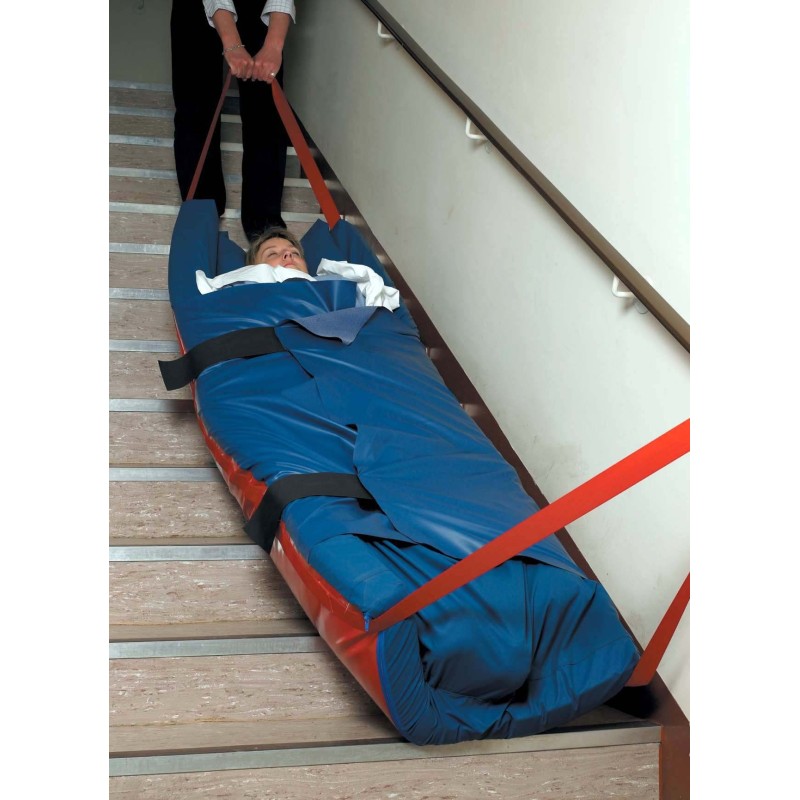

The Evacuation Overlay (NCL-EVO) is a dual-purpose 90mm anti-pressure mattress overlay that remains permanently in bed for daily pressure care, then enables complete patient evacuation from the bed without a patient transfer step. PVC-coated underside slides over all surfaces including stairs; fabric tucks secure to bed and cocoon the patient during evacuation. Two-person operation required.
| Specification | Detail |
|---|---|
| Reference | NCL-EVO |
| Depth | 90 mm anti-pressure foam |
| Top Cover | Vapour-permeable, two-way stretch, wipe-clean |
| Underside | PVC-coated, low-friction sliding |
| Securing | Integrated fabric tucks (bed securing and patient cocooning) |
| Operators | Two trained persons |
The Regulatory Reform (Fire Safety) Order 2005 requires PEEPs for residents with mobility impairments; the Evacuation Overlay provides an in-place evacuation solution that eliminates the patient transfer step, making evacuation faster and reducing the manual handling risk associated with moving immobile residents onto a separate sledge during an emergency. NICE CG179 compliance is maintained through the 90mm anti-pressure foam construction during normal daily use. CQC Regulation 12 requires that evacuation equipment is maintained, accessible, and that staff are trained in its use; the overlay's permanent in-bed position ensures it is always in place and does not need to be retrieved from storage during an emergency.
What is the clinical advantage of the evacuation overlay over a conventional evacuation sledge?
A conventional evacuation sledge (such as NCL-EVSG) is stored separately and must be retrieved and brought to the patient's room before evacuation can begin; the patient must then be transferred from the bed to the sledge - a manual handling task that takes time and requires care staff to safely lift or slide an immobile patient. In a fire emergency, this time delay and handling step can be critical. The Evacuation Overlay eliminates both the retrieval and transfer steps; it is always in place on the bed under the patient, and evacuation begins immediately by sliding the overlay - with the patient already secured on it - from the bed. The time saving in an emergency can be significant, particularly in a care home where multiple residents require simultaneous evacuation assistance.
How do the fabric tucks serve both normal bed use and emergency cocooning?
In normal use, the fabric tucks extend beneath the mattress on both sides of the overlay, with the mattress weight holding them in place to secure the overlay on the bed surface in the same way as the tuck bumpers in the bed safety range. When evacuation is initiated, the mattress is removed and the tucks are folded up and over the patient to form a cocooning layer that wraps and secures the patient within the overlay for transit. The same fabric extensions that secure the overlay during daily use become the patient-securing wraps during evacuation, without requiring additional belts or straps to be applied under emergency pressure. Two trained operators use the head and foot pulling points of the overlay to guide it during stair and corridor evacuation.
