
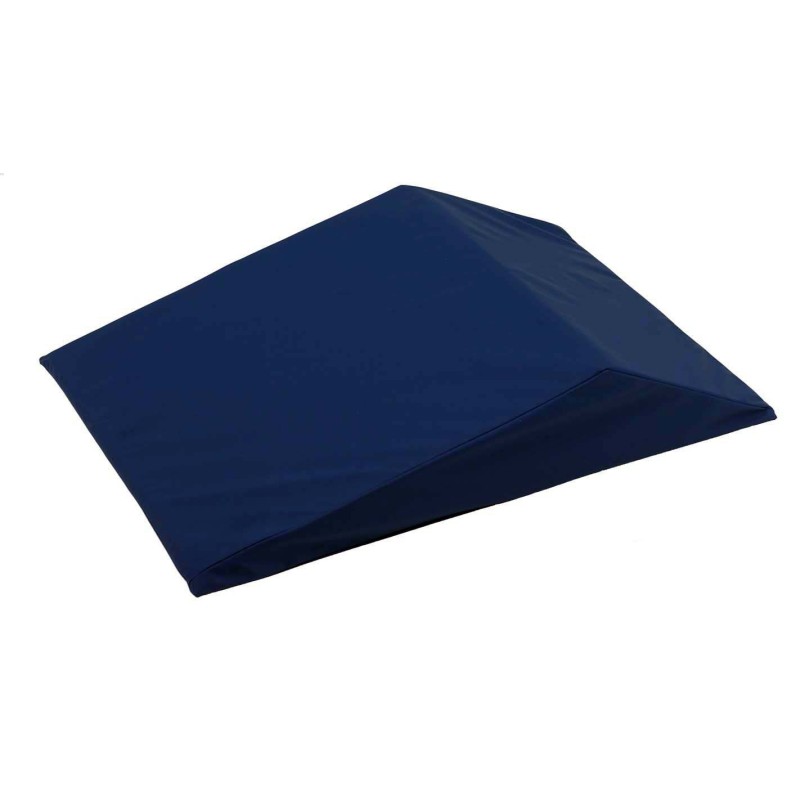

The Double Knee Wedge (NCL-KBW) simulates the profiling bed knee break on flat mattresses, elevating the knees to prevent bed-sliding and offload heel pressure per NICE CG179. High-density foam; non-slip base; vapour-permeable wipe-clean cover. For use where a profiling bed knee break function is not available.
| Specification | Detail |
|---|---|
| Reference | NCL-KBW |
| Foam | High-density |
| Cover | Vapour-permeable, wipe-clean |
| Base | Non-slip |
| Function | Simulates knee break; offloads heel pressure |
NICE CG179 (pressure ulcers: prevention and management) identifies the heel as a high-risk pressure ulcer site and recommends offloading interventions as part of the tissue viability care plan; the double knee wedge contributes to heel offloading through positional elevation of the lower limb. CQC Regulation 12 (safe care) documentation should include the knee wedge within the pressure care plan, with the tissue viability nurse confirming the clinical indication and the appropriate wedge position. MHOR 1992 benefits from the non-slip base maintaining the position without requiring repeated carer interventions to reposition a displaced wedge.
How does the double knee wedge simulate the knee break of a profiling bed?
A profiling bed's knee break section elevates the lower part of the mattress from beneath, raising the resident's knees while supporting the full thigh and lower leg. The double knee wedge replicates this by placing a shaped foam wedge beneath the lower thighs at the knee position; the wedge lifts the knees from below in the same anatomical position as the profiling bed knee break, without requiring the electrically adjustable bed mechanism. For residents on standard flat mattresses - in homecare or where a profiling bed is not in use - the knee wedge provides the same positional benefit as the profiling bed's knee break function.
Why does knee elevation offload pressure from the heel?
When the knees are elevated, the angle at the knee joint causes the lower legs to lift away from the mattress surface; the gravitational pull on the lower leg below the elevated knee means the calf and heel naturally lift free of the mattress, reducing or eliminating the direct contact pressure at the posterior heel. This is the same mechanical principle used in clinical heel floatation devices, but achieved through positional knee elevation rather than a dedicated heel support device. For complete heel offloading - where the heel must be fully suspended - the tissue viability nurse may also recommend a heel protector or leg trough in addition to the knee wedge.