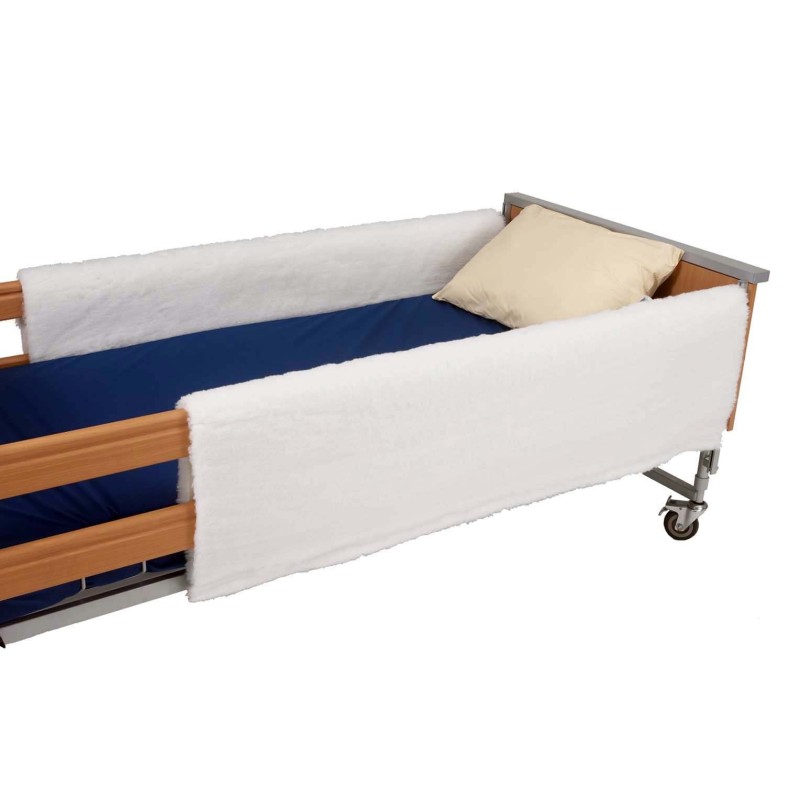

The Deep Pile Polyester Bumper (200x76cm) provides full profiling bed length air-permeable fleece coverage for seizure-prone patients without mattress overlays. Continuous seizure-safe coverage from head to foot. Full-length hook and loop fastening; machine washable. High-sided version is NCL-CSHP3H (200x96cm); shorter versions are NCL-CSHP1 (134cm) and NCL-CSHP18 (183cm).
| Specification | Detail |
|---|---|
| Reference | NCL-CSHP3 |
| Dimensions | 200 x 76 cm (79" x 30") |
| Material | Deep-pile polyester fleece |
| Key Property | Air-permeable |
| Fastening | Full-length hook and loop |
| Washing | Machine washable |
| High-Sided Version | NCL-CSHP3H (200 x 96 cm) |
All compliance requirements applicable across the CSHP range apply. The 200cm length should be confirmed as clinically required by the seizure risk assessment; where the patient's seizure movement is contained within a shorter section of the rail, the 134cm or 183cm versions may provide adequate coverage at lower cost. CQC Regulation 12 documentation should confirm the 200cm length rationale. MHRA bed rail safety guidance, Mental Capacity Act 2005 best interest obligations, and NICE CG137/NG217 seizure safety considerations all apply.
How should the appropriate length be selected across the six CSHP range options?
Length selection across the CSHP range should be based on two independent variables: the required body coverage length (134cm, 183cm, or 200cm) and the required height (standard 76cm or high-sided 96cm). For coverage length, the seizure risk assessment should document the extent of rail the patient contacts during a typical seizure episode, and the bumper length should cover this section plus a safety margin. For height, the presence of a mattress overlay determines whether 76cm or 96cm is required. The six options are: 134x76cm (NCL-CSHP1), 134x96cm (NCL-CSHP1H), 183x76cm (NCL-CSHP18), 183x96cm (NCL-CSHP18H), 200x76cm (NCL-CSHP3), 200x96cm (NCL-CSHP3H).
Should the 200cm full-length version always be specified for maximum safety?
Not necessarily. The appropriate length should be determined by clinical assessment rather than defaulting to the maximum specification. Over-specification introduces unnecessary cost and may make removal and refitting for laundering more burdensome. If the seizure risk assessment establishes that the patient's movement during seizures is confined to a shorter section of the rail, the 134cm or 183cm version provides the required coverage with easier handling. The 200cm version is appropriate where seizure movement consistently extends along the full rail length, or where the clinical team cannot reliably predict the movement extent from the available seizure history.