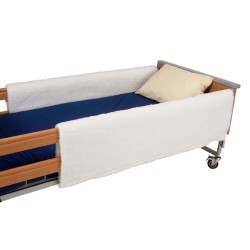
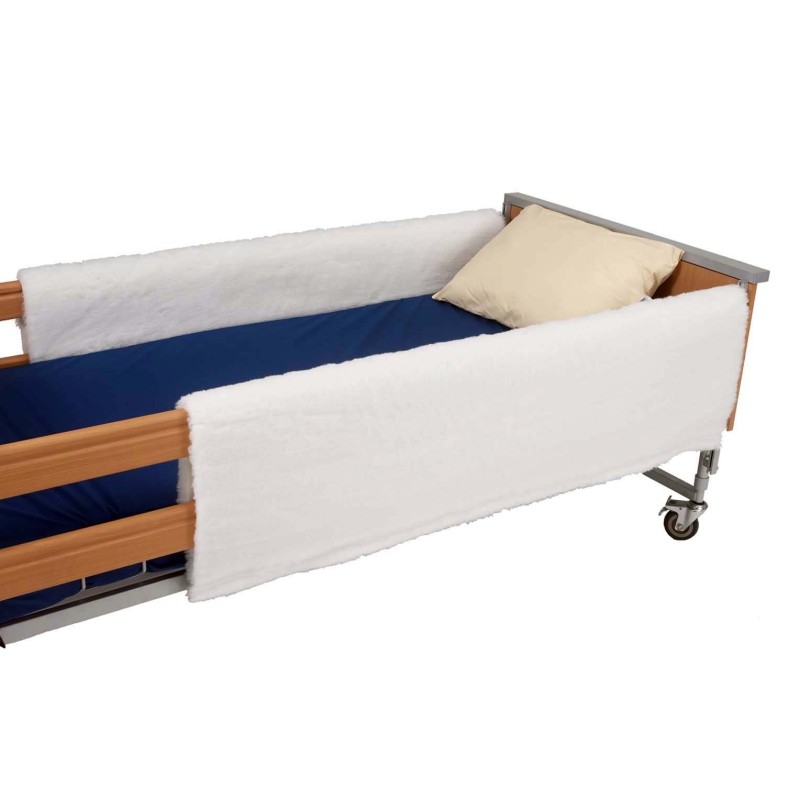

The Deep Pile Polyester Bumper (134x76cm) is the opening size in the CSHP air-permeable fleece bumper range, specifically indicated for patients prone to seizures or involuntary movements where conventional bumper materials that restrict airflow at the face contact point create an additional clinical concern. Full-length hook and loop fastening; machine washable. Full range: NCL-CSHP1H (134x96cm), NCL-CSHP18 (183x76cm), NCL-CSHP18H (183x96cm), NCL-CSHP3 (200x76cm), NCL-CSHP3H (200x96cm).
| Specification | Detail |
|---|---|
| Reference | NCL-CSHP1 |
| Dimensions | 134 x 76 cm (53" x 30") |
| Material | Deep-pile polyester fleece |
| Key Property | Air-permeable |
| Fastening | Full-length hook and loop |
| Washing | Machine washable |
| Clinical Indication | Seizure-prone and involuntary movement patients |
NICE CG137 (epilepsy) and NICE NG217 address seizure safety and the management of patients with epilepsy in care settings; bed rail bumper specifications for epilepsy and seizure-prone patients should consider the risk of face and airway contact with non-permeable surfaces during tonic-clonic or other seizure types. The air-permeable fleece construction directly addresses this concern. CQC Regulation 12 (safe care) documentation should record the seizure risk assessment, the air-permeable bumper specification rationale, and the bed rail risk assessment. MHRA bed rail safety guidance applies. Mental Capacity Act 2005 best interest obligations apply where applicable.
Why is air permeability specifically important for seizure-prone patients?
During a tonic-clonic seizure, the patient may lose control of their positioning and their face may press against the bed rail bumper surface for the duration of the seizure episode. Non-permeable bumper covers - including wipe-clean PU and standard polyester covers - restrict airflow at the contact point, presenting a respiratory risk if the patient's face is in sustained contact. The air-permeable deep-pile polyester fleece allows air to flow through the bumper material, reducing the respiratory risk at the bumper contact point during a seizure. The CSHP range is the appropriate bumper specification where this risk is identified in the clinical and seizure risk assessment for the individual patient.
How does the full-length hook and loop fastening differ from partial-edge fastening?
Standard bumpers with hook and loop fastening only along the bottom edge attach to the lower rail at a single strip point; the remainder of the bumper body is held against the rail by the bottom fastening tension alone. Full-length hook and loop fastening runs the entire length of the bumper, attaching the full bumper surface to the rail at every point along its length. For patients with involuntary movements or seizures, this full-length attachment prevents the bumper from being pushed out of position, buckling, or lifting away from the rail during the physical activity of a seizure episode, maintaining the air-permeable surface in position throughout.