
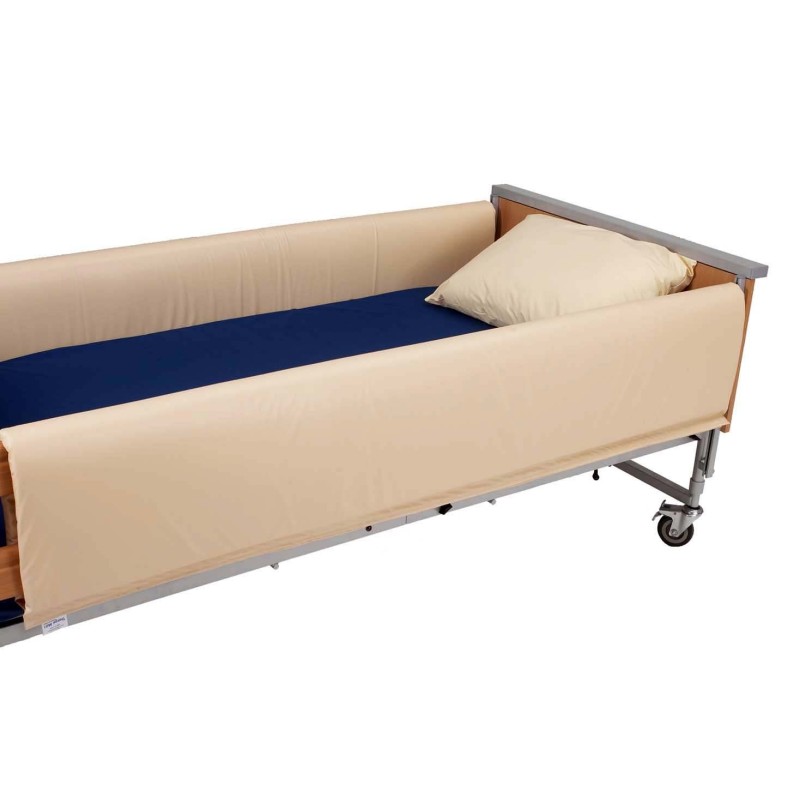

The Conventional Cotside Bumper with Split Base (200x76cm, Standard) provides full-length padded wipe-clean rail protection for standard profiling beds, with a split base that prevents the bumper from contacting the floor when the side rails are lowered. The split base eliminates the floor-contamination pathway created by standard bumpers during routine care access. High-sided 200x96cm version is NCL-CSBPBH-CB; three-rail 200x105cm version is NCL-CSBPBX-CB.
| Specification | Detail |
|---|---|
| Reference | NCL-CSBPB-CB |
| Dimensions | 200 x 76 cm (79" x 30") |
| Key Feature | Split base - floor-clear when rails lowered |
| Cover | Wipe-clean |
| Without Split Base | NCL-CSBPB (200 x 76 cm standard) |
| High-Sided CB Version | NCL-CSBPBH-CB (200 x 96 cm) |
| Three-Rail CB Version | NCL-CSBPBX-CB (200 x 105 cm) |
NHS IPC infection control guidance identifies floor contact as a contamination risk for patient equipment; the split base eliminates this specific risk during routine rail-lowering for care access. CQC Regulation 12 (safe care) requires that bed safety equipment does not expose residents to unnecessary infection risk; the split base design directly supports this by maintaining hygiene of the bumper surface throughout the care workflow. MHRA guidance on bed rail safety applies; a documented bed rail risk assessment confirming the standard 76cm height is appropriate for the bed configuration, the clinical indication, and Mental Capacity Act 2005 best interest considerations is required before fitting.
What is the clinical benefit of the split base compared to the standard bumper without a split base?
When a standard bumper without a split base (NCL-CSBPB) is lowered with the bed rail, the padded cover hangs down and rests on the floor, picking up floor contamination. When the rail is raised, this contaminated surface is brought up to the resident's bedside level, creating a floor-to-bed contamination pathway that occurs multiple times per day during routine care. The split base on the CB version holds the bumper off the floor as the rail is lowered, maintaining the hygiene of the cover throughout the care episode and eliminating this specific contamination pathway.
When should the split base version be specified rather than the standard bumper?
The split base version (NCL-CSBPB-CB) should be specified where the care setting's NHS IPC infection control policy identifies floor contact during rail-lowering as a contamination risk that requires management, or where the clinical team has identified the floor-to-bed contamination pathway as a specific infection control concern for the individual patient or ward environment. In high-acuity or infection-sensitive environments, the split base specification is generally preferred. The standard version (NCL-CSBPB) remains appropriate where floor contact during rail-lowering is not identified as a specific risk in the local infection control assessment.
