
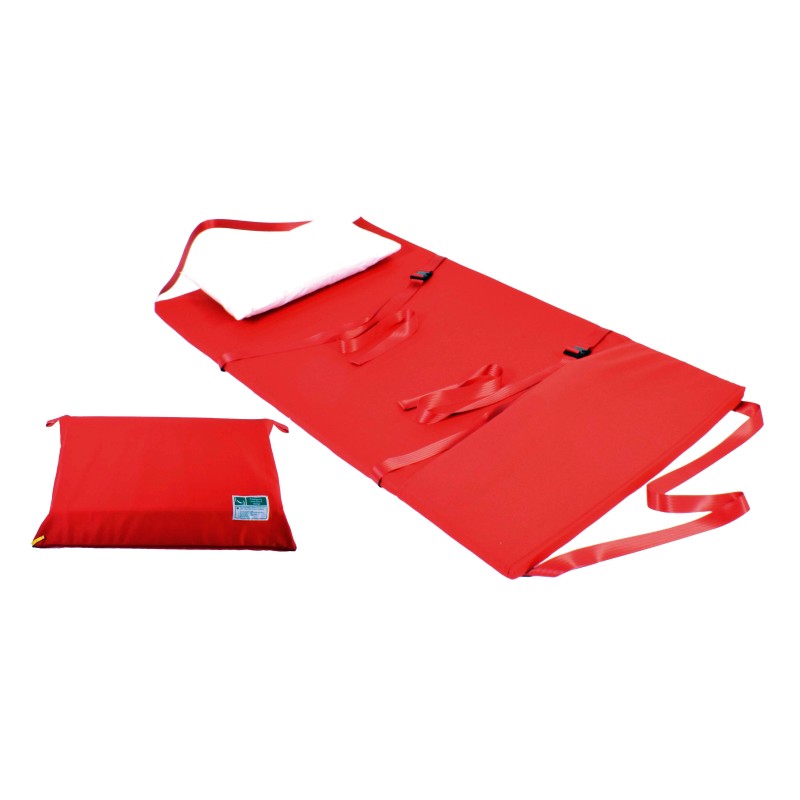

The Bariatric Evacuation Sledge (NCL-EVSG100) provides safe emergency evacuation for bariatric patients at 100cm width with dual-layer heavy-duty foam and full-length webbing rated at over 2 tonnes breaking strength. Wall-mounted storage pouch with sewn instructions. Two trained operators required. Regulatory Reform (Fire Safety) Order 2005 PEEP provision for bariatric residents.
| Specification | Detail |
|---|---|
| Reference | NCL-EVSG100 |
| Width | 100 cm |
| Construction | Dual-layer foam (heavy-duty base; soft top) |
| Webbing | Full-length; breaking strength exceeding 2 tonnes |
| Storage | Heavy-duty wall-mounted pouch with instructions |
| Standard Version | NCL-EVSG (standard width) |
The Regulatory Reform (Fire Safety) Order 2005 requires that PEEPs address the evacuation needs of all residents, including those with higher body weights whose evacuation cannot be safely achieved with standard-capacity equipment. CQC Regulation 12 (safe care) requires that the evacuation equipment specified for each resident's PEEP is appropriate for their individual needs, including weight; specifying a standard sledge for a bariatric resident whose weight exceeds the standard SWL would be a non-compliance with this requirement. The bariatric sledge's 2-tonne webbing provides clear evidence of capacity for regulatory documentation.
What is the clinical importance of a 2-tonne webbing breaking strength for bariatric evacuation?
During stair descent evacuation, the webbing is subject to forces significantly greater than the patient's static weight alone; the dynamic loading from stair-step impacts, sudden stops, and the angle changes during stair navigation apply additional stress to the webbing. For a bariatric patient, these dynamic forces can be substantial. A 2-tonne breaking strength provides a very large safety margin above the expected maximum loading, giving confidence that the webbing will not fail during a real emergency evacuation of a heavy patient on a challenging stairway. Standard evacuation sledge webbing is rated for lighter loads and cannot provide this safety margin for bariatric users.
How does bariatric emergency evacuation differ in practice from standard evacuation?
Bariatric evacuation presents additional challenges in three areas: the higher patient weight requires greater operator effort to initiate movement and control descent speed on stairs; the wider sledge may require wider doorways to be confirmed in the evacuation route before the PEEP is finalised; and repositioning the bariatric patient onto the sledge (if transfer is required from the bed) is a significant manual handling challenge requiring additional staff. The care home's PEEP for each bariatric resident should document the evacuation route including all doorway widths, the number of operators required, and the manual handling risk assessment for any patient transfer onto the sledge. Fire drills should rehearse the full sequence including transfer to the sledge.
