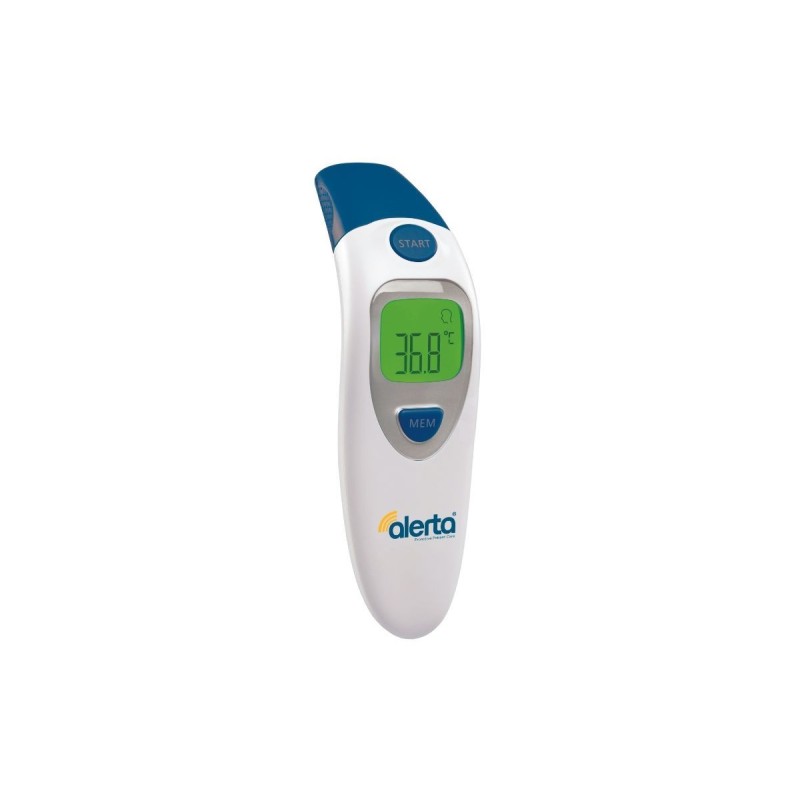

The Alerta Digital Non-Contact Forehead and Ear Thermometer delivers fast, hygienic infrared temperature readings in dual forehead and object temperature modes. Covering the 35-45°C clinical range with a 30-result memory, large LCD backlit display, and automatic 15-second power-down, it is designed for care home, hospital, and family use. Battery-operated (2 x AAA 1.5V), the compact device supports NHS NEWS2 temperature monitoring and NHS IPC infection control requirements for non-contact temperature assessment.
| Specification | Detail |
|---|---|
| Reference | NCL-ALT-DE100 |
| Measurement Method | Non-contact infrared |
| Modes | Body temperature (forehead); object temperature |
| Temperature Range | 35°C - 45°C |
| Temperature Units | °C or °F selectable |
| Memory | Last 30 results |
| Display | LCD backlit |
| Auto Power-Off | 15 seconds |
| Power | 2 x AAA 1.5V batteries |
The Alerta thermometer is an MHRA-regulated device under UK MDR 2002. Non-contact infrared thermometry is accepted within NHS clinical practice for care home temperature monitoring and triage; it is the preferred method during suspected infection episodes to eliminate the cross-contamination risk associated with contact probe use. The 35-45°C measurement range covers the NHS NEWS2 temperature parameters, which score readings below 35°C or at or above 39°C. CQC Regulation 12 (safe care) equipment obligations are met by the non-contact design, which requires no probe cover replacement and no decontamination between uses.
Is non-contact infrared measurement accepted for NHS NEWS2 early warning score monitoring?
Yes. Non-contact infrared forehead thermometry is accepted within NHS clinical practice for care home NEWS2 temperature monitoring. It is particularly recommended during suspected infection episodes where contact thermometry would increase cross-contamination risk. The 35-45°C range covers all clinically significant NEWS2 temperature thresholds, and the 30-result memory supports trend review at clinical handover. Local clinical governance protocols should specify acceptable measurement methods and variance thresholds for critical temperature-dependent decisions.
Does the object temperature mode have clinical applications in a care home setting?
The object temperature mode can be used to check the surface temperature of equipment, food, or liquids where temperature verification is a care plan or safety protocol requirement - for example, checking bath water temperature for residents with reduced skin sensation, or verifying the temperature of warmed fluids. It is not a replacement for calibrated thermometers used in clinical food safety or sterile field protocols, but it provides a useful additional function for care home environmental monitoring.
Part of our professional Clinical Medical Equipment range. Medical thermometers provide accurate temperature monitoring for infection control and patient assessment in care settings.