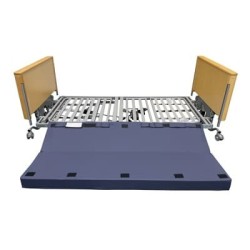


The Woburn Ultra-Low Profiling Bed achieves a 67mm minimum floor height, the lowest in the Woburn range, for maximum fall prevention in the highest-risk residents. Auto-regression and Trendelenburg are standard functions. The 67-640mm height range provides both the near-floor position and carer working access at 640mm. SWL 185kg; maximum user weight 175kg. Overall 2130 x 900mm; 81kg. Low-voltage; IPX4; battery backup; lockable handset. Oak and walnut finish options. MHRA compliant.
| Specification | Detail |
|---|---|
| Frame SWL | 185kg (29 stone) |
| Maximum User Weight | 175kg (27 stone) |
| Height Range | 67 - 640mm |
| Overall Dimensions | 2130 x 900mm |
| Total Bed Weight | 81kg |
| Backrest Angle | Up to 70 degrees |
| Knee Rest Angle | Up to 30 degrees |
| Auto-Regression | Standard (included) |
| Trendelenburg | Standard (included) |
| Power Supply | Low-voltage |
| Motor Protection | IPX4 |
| Safety Features | Emergency battery backup; lockable handset |
| Head and Footboards | Oak or walnut; enclosed panel option available |
| Reference | NCL-HLB799.03AR |
| Compliance | MHRA guidelines; NICE NG45 (falls management) |
The Woburn Ultra-Low Profiling Bed complies with MHRA profiling bed guidelines. Ultra-low deployment at 67mm requires an individual falls risk assessment per NICE NG45 documenting the clinical need for this minimum height; where the ultra-low position replaces bed rail use, a best interest decision under the Mental Capacity Act 2005 must be documented. SWL and user weight must be verified per MHOR 1992. The height management protocol ensuring the bed is returned to 67mm position after each care visit must be documented and included in staff training. Equipment register records must be maintained for CQC Regulation 12 compliance.
Is 67mm floor height significantly safer than 90mm, and what clinical justification exists for choosing the absolute lowest position?
The clinical significance of the difference between 67mm and 90mm minimum height depends on how close to absolute floor level is required for the specific resident's risk profile. For most residents requiring an ultra-low bed, the difference between 67mm and 90mm in terms of fall injury risk is marginal; both positions place the resident very close to the floor and dramatically reduce fall impact energy compared to standard bed heights. However, for residents with very high fall frequency, very low body weight, or bone fragility where even a 23mm difference in fall height translates to a meaningful injury risk reduction, or for residents where the presence of a foam fall mat at 67mm reduces the effective fall distance to near-zero in a way that 90mm + mat cannot fully replicate, the absolute minimum of 67mm may be clinically justified. The prescribing clinician must document in the falls risk assessment why 67mm is specifically indicated rather than the 90mm minimum of the Ultra Low 800, as this clinical rationale will be the basis for the falls management plan and the subsequent review process.
How does the enclosed panel headboard option affect infection control, and when is it indicated?
The enclosed panel headboard replaces the open-frame wooden head and footboard design with a solid panel construction that eliminates the gaps and recesses present in an open frame that can harbour dust, moisture, and microbial contamination. Standard open-frame headboards have multiple contact surfaces including the frame rails, the cross-members, and the joints between them, each of which requires individual wiping during decontamination; an enclosed panel has a continuous smooth surface that can be wiped with a single pass. The enclosed panel option is indicated in settings where the enhanced decontamination efficiency is a clinical priority, particularly for residents with active infections, immunocompromised status, or where the bed will be shared between residents with high cross-contamination risk. The enclosed panel also provides a more aesthetically integrated appearance that some care home residents find more comfortable and homelike than an open clinical frame, which has wellbeing and dignity benefits per CQC Regulation 10 in addition to the infection control advantage.