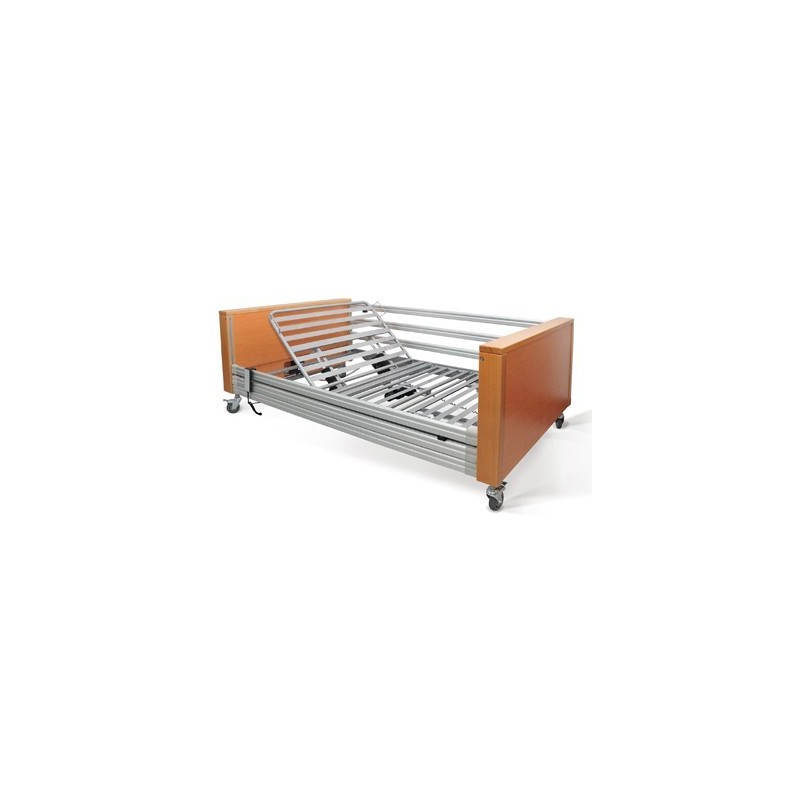

The Woburn Ultimate Plus Size Profiling Bed supports bariatric patients up to 317kg (50 stone) user weight on a 381kg (60 stone) rated frame, available in 1200mm and 1400mm widths with optional 200mm length extension. Aluminium side rails with two-handed release prevent accidental opening during bariatric care. Maximum mattress depth 260mm for bed rail entrapment compliance. Height 275-690mm. Auto-regression, Trendelenburg, emergency battery backup. Lockable handset. MHRA compliant; braked castors.
| Specification | Detail |
|---|---|
| Frame SWL | 381kg (60 stone) |
| Maximum User Weight | 317kg (50 stone) |
| Available Widths | 1200mm and 1400mm |
| Optional Extension | 200mm length extension for tall patients |
| Height Range | 275 - 690mm |
| Side Rails | Aluminium - two-handed operation |
| Maximum Mattress Depth | 260mm (bed rail compliance limit) |
| Positioning Functions | Electric backrest; knee break; mechanical lower leg; Trendelenburg; auto-regression |
| Safety Features | Emergency battery backup; lockable handset; braked castors |
| Compliance | MHRA guidelines; bed rail entrapment regulations |
The Woburn Ultimate Plus Size Profiling Bed complies with MHRA guidelines for profiling beds and bed rail safety, including the two-handed rail release requirement and the maximum mattress depth specification for entrapment prevention. The frame SWL of 381kg must not be exceeded; the maximum user weight of 317kg must be verified against the resident's documented weight per MHOR 1992 before deployment. Any mattress deployed in this bed must be confirmed at or below 260mm depth to maintain bed rail compliance; this confirmation must be documented in the equipment register. The electrical components meet the low-voltage and safety requirements applicable to electric profiling beds. CQC Regulation 12 compliance documentation must include the bed, mattress, and rail configuration records for each resident.
Why is there a maximum mattress depth limit of 260mm, and what happens if a mattress deeper than this is fitted?
MHRA bed rail safety guidance specifies maximum and minimum gaps between the mattress surface and the top of the bed rail, measured when the mattress is compressed under the user's weight. If the mattress is too thick, the sleeping surface rises above the effective height of the rail, reducing the lateral containment provided by the rail and increasing the risk of the user rolling over the top of the rail. The 260mm maximum mattress depth for the Woburn Ultimate is the depth at which the mattress surface, when compressed under a bariatric user's weight, remains at or below the MHRA-compliant relationship with the rail height. Fitting a mattress deeper than 260mm raises the compressed sleeping surface above this threshold, which constitutes a bed rail entrapment non-compliance - not an entrapment between the mattress and the rail, but a rolling-out risk over the rail. This applies regardless of how clinically indicated the deeper mattress may be; if the available mattresses meeting the clinical specification exceed 260mm, the clinical team must seek manufacturer guidance on rail height adjustment or select a different mattress within the depth limit.
What is auto-regression in a profiling bed and why is it clinically important in bariatric care?
Auto-regression is a mechanism in which the entire sleeping platform shifts toward the foot of the bed as the headboard section is raised. When a standard profiling bed raises its headboard, the resident's body slides downward toward the foot of the bed under gravity and friction, creating shear forces at the sacrum as the skin and underlying tissue are pulled in different directions - the skin stays in contact with the mattress while the deeper tissues move with the skeleton. This shear force is a well-documented mechanism for pressure injury at the sacral zone, and is particularly pronounced in bariatric care where the higher body mass generates greater gravitational and frictional forces during headboard elevation. Auto-regression counters this by moving the whole platform toward the foot end at the same rate as the headboard rises, keeping the resident's body in the same relative position on the mattress regardless of backrest angle. This eliminates the sacral shear force associated with headboard elevation and is therefore a clinically important feature in bariatric profiling bed specification, where sacral pressure injury risk is already elevated.