
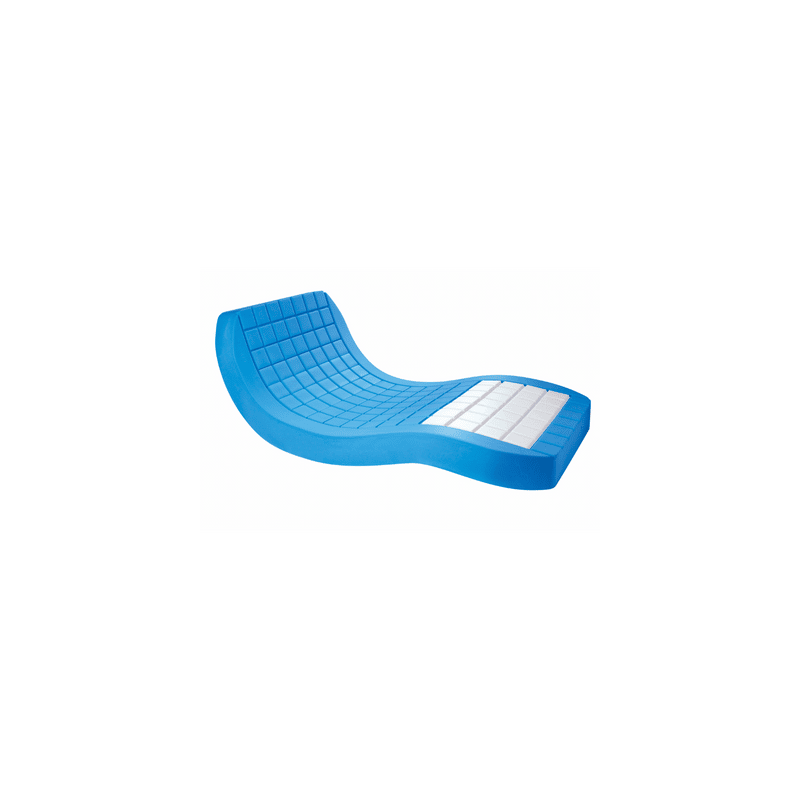

The Viscoflex Multi-bearing Mattress uses an anatomical multi-bearing foam design with softer foam at the heel zone for maximum immersion and firmer foam with a specifically designed sacral geometry to optimise contact area without foam softness at the sacrum. The 80kg/m³ Viscofoam® top layer provides the slow-return conforming surface across both zones. Crib 5 welded VP antibacterial PU cover. HR foam core. SWL 130kg (20 stone) - verify before deployment. 1990 x 860 x 140mm; 3-year warranty. Very high-risk indication per NICE CG179.
| Specification | Detail |
|---|---|
| Top Layer | 80kg/m3 Viscofoam - anatomical multi-bearing design |
| Heel Zone | Softer foam for maximum immersion and contact area |
| Sacral Zone | Firmer foam with anatomical geometry for contact area without bottoming out |
| Base | High-resilience foam |
| Cover | 4-way stretch VP PU - antibacterial, Crib 5, welded seams |
| Dimensions | 1990 x 860 x 140mm |
| Safe Working Load | 130kg (20 stone) - verify before deployment |
| Reference | NCL-P161MFPPMHF |
| Warranty | 3 years |
| Clinical Risk Level | Very high risk per NICE CG179 |
The Viscoflex Multi-bearing is a Class I passive medical device under Medical Devices Regulation 2017/745. Clinical selection requires validated pressure risk assessment per NICE CG179 confirming very high-risk status. The SWL of 130kg is a hard limit; SWL must be verified against the resident's documented weight before deployment per MHOR 1992 and this mattress must not be used above 130kg. The 1990 x 860mm footprint requires bed frame compatibility confirmation before procurement, particularly with reference to MHRA bed rail entrapment guidance. The Crib 5 welded cover meets BS 5852 fire safety requirements. Equipment register records, SWL verification, and MDR conformity documentation must be maintained for CQC Regulation 12 compliance.
Why is the heel zone softer and the sacral zone firmer in the multi-bearing design, when the sacrum is generally considered the highest-risk pressure site?
The multi-bearing design responds to two different biomechanical problems that require different foam solutions. The heel presents a very small contact area under a focused load - the heel bone (calcaneus) has a small, bony, relatively unyielding surface, and all of the lower leg weight is concentrated through it; the interface pressure per unit area is therefore extremely high. The clinical solution to high interface pressure from a small contact area is to increase the contact area as much as possible, which is achieved by allowing the heel to sink into the softest available foam, maximising the foam-to-heel contact perimeter and distributing the load over a larger surface. Softer foam at the heel zone achieves this through maximum immersion. The sacrum, by contrast, has a larger contact area and the full weight of the posterior trunk concentrated through it, which creates a different problem: the risk of bottoming out through soft foam under high total load. At the sacrum, a harder foam that maintains its structure under load while using anatomical surface geometry to increase contact area is clinically more effective than soft foam that risks bottoming out at the sacral zone. The multi-bearing design therefore uses softness to solve the heel problem (small area, high pressure) and geometry to solve the sacral problem (large load, bottoming-out risk).
How does the Viscoflex Multi-bearing differ clinically from the Viscoflex Evolutive, and which should be prescribed?
Both the Multi-bearing and Evolutive are Viscoflex-range very high-risk static mattresses with 130kg SWL, 80kg/m³ Viscofoam, and similar overall dimensions. The clinical distinction is the foam arrangement strategy. The Evolutive uses precision-zoned foam inserts to vary density at different body zones, targeting both immersion and structural support through density variation alone. The Multi-bearing adds an anatomical geometry design at the sacral zone, using the three-dimensional shape of the foam surface to maximise sacral contact area in a way that density variation alone cannot achieve. This makes the Multi-bearing the more appropriate selection when the prescribing clinician's assessment identifies sacral pressure concentration as the primary risk site requiring targeted optimisation, because the anatomical sacral geometry is specifically engineered for that purpose. The Evolutive is more broadly applicable across the full risk site profile (sacrum, heels, occiput) through its zoned density approach. For a resident whose primary clinical concern is heel pressure concentration alongside sacral risk, the Multi-bearing's dedicated heel immersion zone may provide clinical benefit over the more generalised Evolutive zoning approach.
