
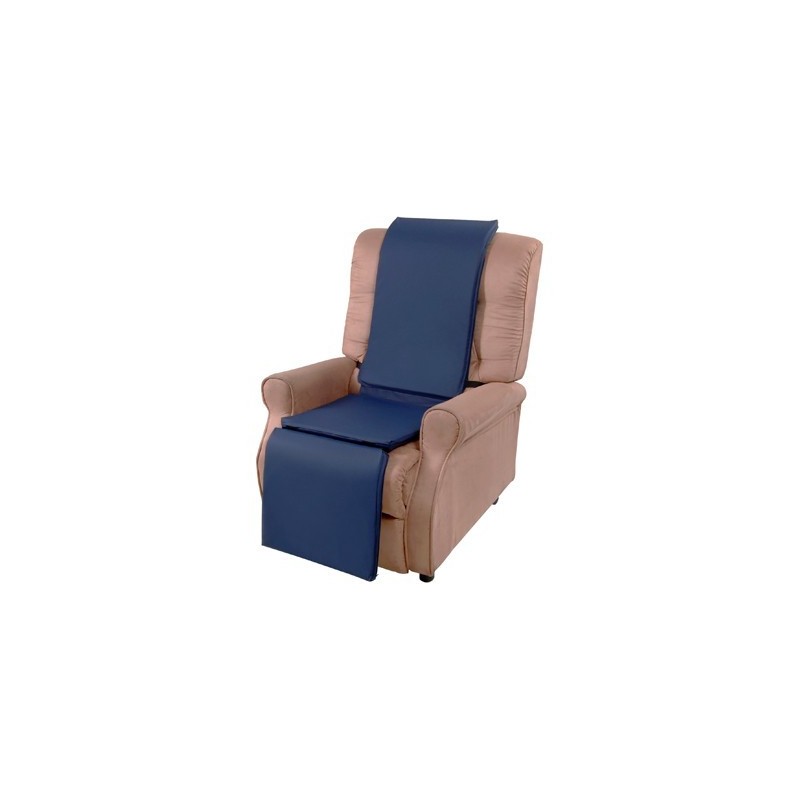


The Ultra-Thin Cushion provides high-risk seated pressure redistribution in a 35mm viscoelastic foam profile specifically designed for rise-recliner chairs, where maintaining the seat-to-armrest height relationship excludes standard-depth cushions. Available in two sizes (NCL-HFC143: 430x430x35mm; NCL-HFC143.20: 508x508x35mm) and as a complete system (NCL-HFC143COM) adding leg and lumbar components. VP water-resistant zipped cover; non-slip base. SWL 152kg. Pairs with Reflect 2 mattress. MDR 2017/745 Class I medical device.
| Specification | Detail |
|---|---|
| NCL-HFC143 | 430 x 430 x 35mm - seat cushion |
| NCL-HFC143.20 | 508 x 508 x 35mm - seat cushion (larger) |
| NCL-HFC143COM | Complete system - seat, leg, and lumbar components |
| Foam Type | Viscoelastic (35mm depth) |
| Cover | 4-way stretch zipped VP water-resistant |
| Base | Non-slip |
| Safe Working Load | 152kg (23 stone) |
| Intended Chair | Rise-recliner chairs |
| Paired Mattress | Reflect 2 (NCL-HFR147) |
| Clinical Risk Level | High risk per NICE CG179 |
| Regulatory Status | MDR 2017/745 Class I medical device |
The Ultra-Thin Cushion is a Class I medical device under MDR 2017/745. Clinical selection requires occupational therapist assessment per NICE CG179. For recliner chair use, the recliner manufacturer's specification for maximum seat cushion depth must be confirmed before prescribing; fitting a cushion above the specified depth tolerance may compromise the recliner mechanism and void the chair warranty. SWL of 152kg must be verified per MHOR 1992. Equipment register records and MDR conformity documentation must be maintained for CQC Regulation 12 compliance.
Why can a standard-depth visco cushion not be used in a rise-recliner chair, and what happens if one is fitted?
A rise-recliner chair is designed with a specific relationship between the seat height, the armrest height, the footrest position, and the reclining mechanism geometry. Adding a cushion raises the resident's seated position by the cushion depth, which has several consequences: the armrests - which were at the correct height to support the resident's elbows when seated on the bare seat - may now be at or below elbow level, reducing lateral support and increasing the risk of lateral sliding; the footrest, which was at the correct height for the resident's leg length, may now be too low, increasing the hip angle and altering posture; and the reclining mechanism may not accommodate the additional seat surface height within its design range, preventing full recline or creating mechanical stress. The 35mm depth of the Ultra-Thin Cushion minimises all of these effects compared to a 76-100mm standard cushion, while still providing a meaningful viscoelastic pressure redistribution layer. Fitting a standard-depth cushion in a recliner without confirming the chair's tolerance for additional seat height is a clinical and equipment safety risk that the prescribing occupational therapist must assess before issuing any seating cushion for recliner use.
What does the complete NCL-HFC143COM system include, and when is it clinically indicated over the seat cushion alone?
The NCL-HFC143COM complete system includes the seat cushion component, a leg cushion that provides viscoelastic pressure redistribution at the posterior calf and heel contact zone of the recliner footrest, and a lumbar support piece that provides postural support at the lower back contact zone of the recliner backrest. The seat cushion alone addresses the ischial tuberosities and posterior thigh, which are the primary seated pressure sites; the complete system extends the pressure redistribution to the secondary contact sites of the calf, heel, and lumbar spine. The complete system is clinically indicated for residents who spend four or more hours per day in the recliner and who have elevated pressure risk at multiple body contact zones, not only the seat base. NICE CG179 requires that pressure care covers all surfaces and positions; for a resident whose daytime care occurs primarily in a recliner chair, the complete system provides a more thorough 24-hour pressure care approach than the seat cushion alone. The occupational therapist must assess all contact zones during the seating assessment and document the clinical rationale for each component included in the prescription.
