
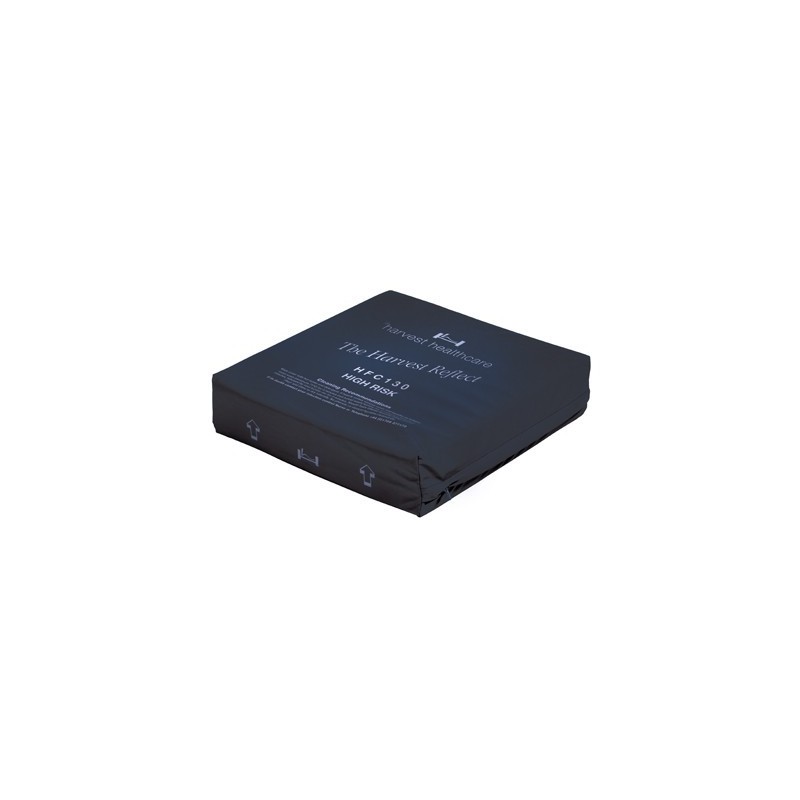


The Reflect Cushion provides high-risk seated pressure redistribution using a castellated viscoelastic foam top layer on a high-density base, combining slow-return visco conforming with the passive airflow of the castellated profile for skin microclimate management. The four-way stretch breathable water-resistant VP zipped cover maintains the airflow benefit of the castellated foam without obstructing the ventilation channels. Non-slip base. SWL 127kg. 430 x 430 x 100mm. Pairs with Reflect 2 mattress for 24-hour care. MDR 2017/745 Class I medical device.
| Specification | Detail |
|---|---|
| Top Layer | Castellated viscoelastic foam |
| Base | High-density foam with non-slip underside |
| Cover | 4-way stretch breathable VP water-resistant - zipped (navy blue) |
| Dimensions | 430 x 430 x 100mm |
| Safe Working Load | 127kg (20 stone) |
| Paired Mattress | Reflect 2 (NCL-HFR147) |
| Reference | NCL-HFC130 |
| Clinical Risk Level | High risk per NICE CG179 |
| Regulatory Status | MDR 2017/745 Class I medical device |
The Reflect Cushion is a Class I medical device under MDR 2017/745. Clinical selection requires occupational therapist assessment confirming high-risk seating need per NICE CG179. SWL of 127kg must be verified against the resident's documented weight per MHOR 1992; residents above 127kg require a higher SWL seating device. Equipment register records and MDR conformity documentation must be maintained for CQC Regulation 12 compliance.
What is the clinical benefit of a castellated viscoelastic surface compared to a flat viscoelastic surface in a seating cushion?
A flat viscoelastic surface provides pressure redistribution through immersion and envelopment but has limited passive airflow; the visco foam forms a continuous contact surface that conforms to the resident's body but also traps heat and moisture at the skin interface over time, as there are no channels through which air can circulate. The castellated profile introduces defined air channels between the foam columns that remain partially open even under seated load, allowing passive airflow to carry heat and moisture vapour away from the skin contact zone during extended sitting. For residents who generate significant seated skin temperature or who are prone to moisture-related skin breakdown, this microclimate benefit directly reduces a documented contributing factor to pressure injury development per NICE CG179. The castellated profile also allows the foam columns to deform laterally into the channels under load, which can increase the effective contact area at bony prominences compared to a flat visco surface of the same density.
Why is the Reflect Cushion at 100mm depth deeper than most other visco seating cushions in this range?
The 100mm total depth of the Reflect Cushion provides a deeper foam profile than the 75-80mm standard visco cushions, allowing a greater depth of viscoelastic foam above the HD base before the base layer's influence on the seated surface is felt. In a shallower visco cushion, the firm base can be felt by residents at or near the SWL limit as the visco layer compresses under full seated load; the additional depth reduces the risk of this bottoming-out sensation and maintains the conforming visco surface even at higher seated loads within the 127kg SWL. The deeper profile also raises the resident's seated height by 100mm rather than 75mm, which must be factored into the footrest and transfer safety assessment before the cushion is issued; the occupational therapist must confirm that the additional seat height does not compromise transfer safety or introduce a new fall risk from the higher seated position.
