
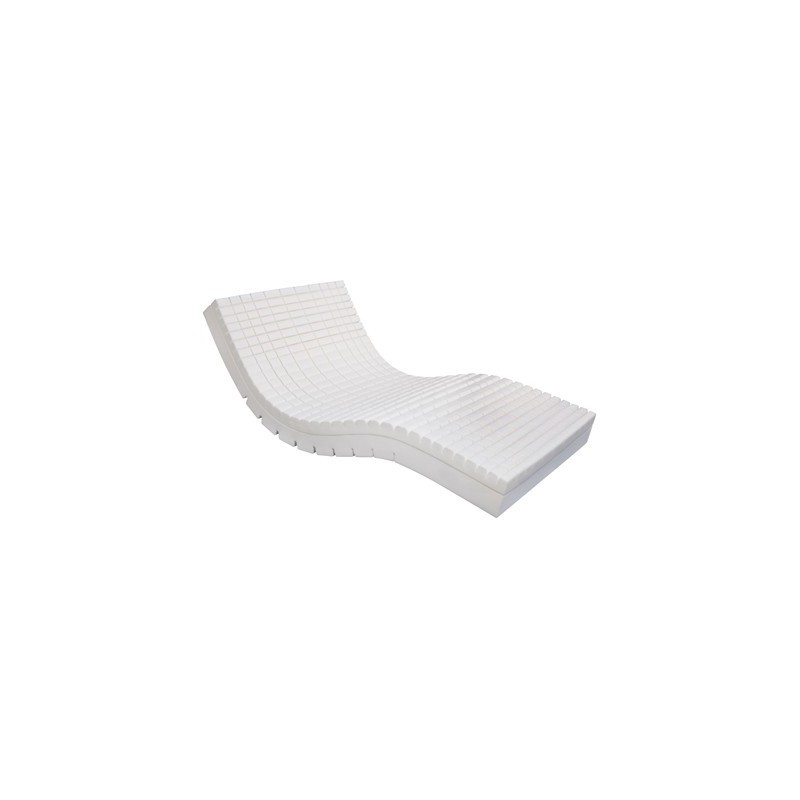

The Reflect 2 is a no-turn high-risk static mattress providing castellated viscoelastic pressure redistribution across a range from standard single (2000 x 900 x 165mm, 247kg) to extreme bariatric (2000 x 1400 x 180mm, 381kg). The no-turn design removes the scheduled mattress turning task. The castellated visco top provides immersion and envelopment at risk sites; the keyhole-slot foam base supports electric profiling bed compatibility. Four-way stretch VP antibacterial PU cover with zipped and welded seams on standard sizes; stitched seams on bariatric variants. 3-year warranty.
| Specification | Detail |
|---|---|
| NCL-HFR147 | 2000 x 900 x 165mm - up to 247kg (39 stone) |
| NCL-HFR147.12 | 2000 x 1200 x 165mm - up to 247kg (39 stone) |
| NCL-HFR147.1370 | 2000 x 1370 x 165mm - up to 247kg (39 stone) |
| NCL-HFR227 | 2000 x 1200 x 180mm - up to 285kg (45 stone) |
| NCL-HFR227.14 | 2000 x 1400 x 180mm - up to 285kg (45 stone) |
| NCL-HFR227.60 | 2000 x 1200 x 180mm - up to 381kg (60 stone) |
| NCL-HFR227.1400.60 | 2000 x 1400 x 180mm - up to 381kg (60 stone) |
| Top Layer | Castellated viscoelastic foam |
| Base | Firm foam with keyhole profiling slots |
| Cover | 4-way stretch VP antibacterial PU - zipped and welded (standard); stitched (bariatric) |
| Warranty | 3 years |
| Clinical Risk Level | High risk per NICE CG179 |
The Reflect 2 is a Class I passive medical device under Medical Devices Regulation 2017/745. Clinical selection requires validated pressure risk assessment per NICE CG179 confirming high-risk status. SWL must be verified against the resident's documented weight per MHOR 1992; for bariatric configurations the specific SWL of the selected variant must be confirmed before procurement. No-turn status must be documented in the equipment maintenance plan, removing this mattress from the scheduled turning programme. The stitched seam construction on bariatric variants provides a different IPC decontamination profile than welded seams; the infection control lead must confirm the decontamination protocol applicable to stitched seams for the specific care environment. Equipment register records and MDR conformity documentation must be maintained for CQC Regulation 12 compliance.
What is the clinical rationale for a no-turn mattress design, and how is the turning task eliminated?
Standard two-sided static mattresses require regular turning to distribute wear and compression set evenly across both foam faces, extending the mattress service life and maintaining consistent pressure redistribution on whichever face is in use. This turning is a physical handling task - typically requiring two carers to lift and rotate the mattress - carried out monthly or at the intervals specified in the mattress maintenance schedule. The Reflect 2 eliminates this requirement because its construction is optimised for use on a single face only: the castellated visco top is the clinical pressure care surface, and the keyhole-slot firm base is the support structure; reversing the mattress would place the base profile in contact with the resident, which is not the intended clinical use. The no-turn design therefore eliminates the turning task not by improving durability per se, but by adopting a deliberately single-sided construction where turning has no clinical purpose. This removes a regular two-person manual handling task from the care team's schedule, reduces the risk of mattress damage during turning manoeuvres, and eliminates the risk of the mattress being replaced in the incorrect orientation after turning.
Why do the bariatric variants use stitched seams rather than the welded seams of the standard Reflect 2?
Welded seam construction bonds the cover panels by heat-fusing the PU material at the join, which requires the cover geometry to be compatible with the welding process. For very large mattress dimensions - particularly the 1370mm, 1400mm, and 60-stone configurations - manufacturing the cover with fully welded seams across all panel joins becomes structurally complex; the greater dimensions and the higher mechanical loads placed on the cover during repositioning and handling increase the risk of weld separation at the seam under bariatric load if the weld bond is not consistently achieved across the full seam length. Stitched seams on the bariatric variants provide the structural security required for the larger panel sizes and higher load conditions, at the cost of the enhanced fluid resistance of a fully welded seam. For the bariatric Reflect 2, the infection control lead should review whether the standard wipe-clean decontamination protocol applicable to stitched seam mattresses is appropriate for the clinical setting, and whether additional decontamination steps at the seam lines are required following incontinence events or wound exudate exposure.
