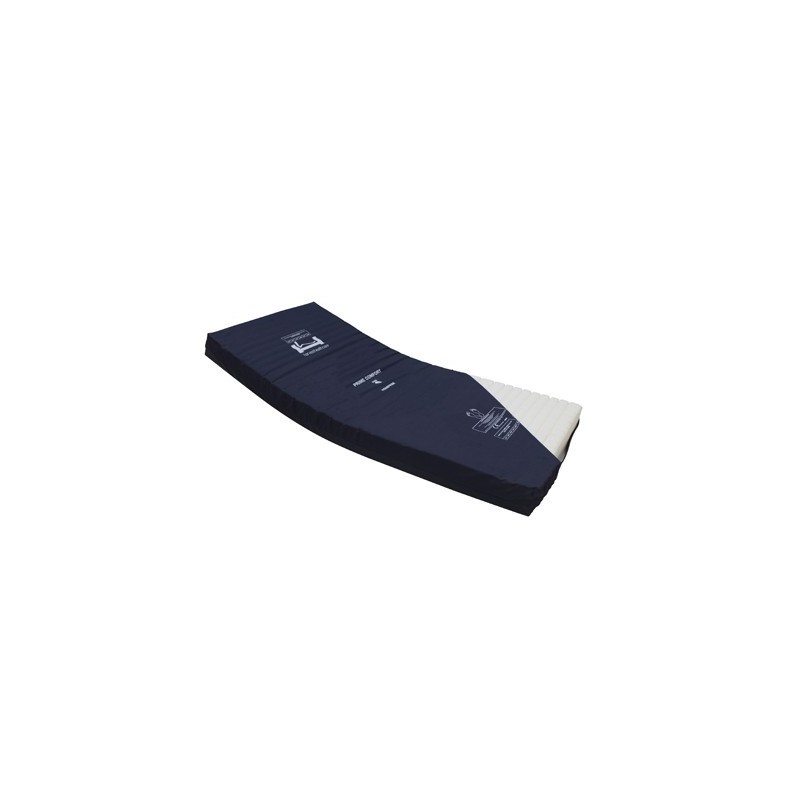


The Prime Comfort Static Mattress provides high-risk pressure redistribution using zonal castellated high-resilience foam that targets relief at the areas of highest clinical risk while maintaining airflow channels for skin microclimate management. The 4-way stretch antibacterial VP PU cover with welded seams and Crib 5 fire safety rating delivers NHS IPC compliance above the stitched-seam standard of the Community range. SWL 177kg (28 stone). 2000 x 900 x 150mm; 9kg; additional sizes on request. Suitable for profiling beds at high pressure risk per NICE CG179.
| Specification | Detail |
|---|---|
| Foam Type | High-resilience castellated CMHR foam (zonal design) |
| Cover | 4-way stretch VP PU - antibacterial, water resistant, Crib 5, welded seams |
| Dimensions | 2000 x 900 x 150mm (additional sizes on request) |
| Weight | 9kg |
| Safe Working Load | 177kg (28 stone) |
| Fire Standard | Crib 5 (BS 5852) |
| Seam Type | Welded (improved IPC over stitched seams) |
| Reference | NCL-HSMPRIM |
| Clinical Risk Level | High risk per NICE CG179 |
| Bed Compatibility | Profiling beds |
The Prime Comfort Static Mattress is a Class I passive medical device under Medical Devices Regulation 2017/745. Clinical selection requires validated pressure risk assessment per NICE CG179 confirming high-risk status. SWL must be verified against the resident's documented weight before deployment per MHOR 1992. The Crib 5 welded PU cover meets the BS 5852 institutional fire safety standard required for care home use under the Regulatory Reform (Fire Safety) Order 2005. Welded seams provide enhanced fluid resistance compared to stitched alternatives; the cover must be inspected for seam integrity at each cleaning episode and removed from service if any weld separation is detected. Equipment register records and MDR conformity documentation must be maintained for CQC Regulation 12 compliance.
How does the castellated foam design provide pressure relief, and what is a castellated foam profile?
Castellated foam has a surface profile cut into columns or peaks separated by recessed channels, rather than a flat continuous surface. Under load, the foam columns compress and deform laterally into the channels, allowing the surface to conform more closely to the body contours than flat foam of the same specification. This increased conformity distributes the resident's weight across a larger contact area and reduces the concentration of pressure at bony prominences such as the sacrum and heels. The channels between the castellations serve a second function: they remain as open air gaps between the foam columns when the surface is unloaded or lightly loaded, allowing passive airflow through the sleeping surface. This airflow carries heat and moisture vapour away from the skin interface, reducing the temperature and humidity at the skin contact surface that contribute to maceration and pressure injury risk per NICE CG179. The zonal arrangement of the Prime Comfort's castellations places denser or differently profiled zones at the areas of highest clinical priority - the sacral, heel, and shoulder zones - to target the greatest conformity benefit where the pressure risk is concentrated.
Why do welded seams provide better infection control than stitched seams, and does it affect durability?
Stitched seams join the cover panels using thread that passes through the cover material at regular intervals, leaving microscopic holes at each stitch point through which fluid, bacteria, and soil can penetrate into the seam and beneath the cover. Even when the cover surface is intact and wipe-clean, these stitch holes are difficult to decontaminate fully with standard wipe-clean cleaning methods and can harbour microbial contamination over time, particularly following incontinence events or wound exudate exposure. Welded seams join the cover panels by heat-bonding the PU material directly to itself without stitching, creating a continuous fluid-resistant bond with no needle holes and no thread to contaminate. The resulting seam is as fluid-resistant as the cover surface itself and is fully decontaminated by the same wipe-clean process used for the rest of the cover. In terms of durability, welded seams perform comparably to high-quality stitched seams under normal use conditions and are generally more resistant to peel separation under repeated fluid and cleaning agent exposure, making them the preferred construction for care settings where incontinence and frequent cleaning are routine.