
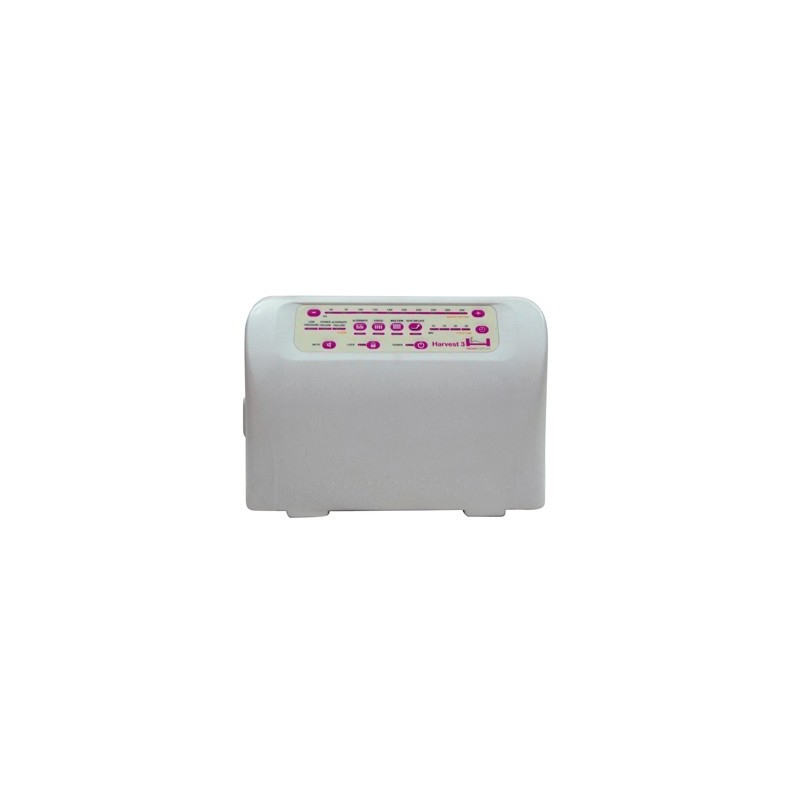


The Harvest 3 is the most advanced pump in the Harvest Healthcare range, providing four selectable cycle times (10, 15, 20, and 25 minutes), static and maxi-firm modes, and the airflow performance required for bariatric 1200mm mattress systems. It is the sole compatible pump for the Hampton Extra and Duke Extra 2.0 bariatric mattresses. The 30-70mmHg pressure range covers standard and bariatric clinical requirements. LED display, lockout, and audible and visual alarms are standard. EN60601-1:2006 and A11:2011 certified. 3.5kg; 340 x 125 x 220mm.
| Specification | Detail |
|---|---|
| Control Type | Digital with LED display |
| Cycle Time Options | 10, 15, 20, 25 minutes (selectable) |
| Additional Modes | Static mode; Maxi-Firm mode; Lockout |
| Pressure Range | 30-70 mmHg |
| Alarms | Audible and visual (low pressure; power failure) |
| Weight | 3.5kg |
| Dimensions | 340 x 125 x 220mm |
| Voltage | 230v / 50Hz; Fuse T1A 250v |
| Safety Standard | EN60601-1:2006 and A11:2011 |
| Compatible Mattresses | All Harvest active mattresses including bariatric (Hampton Extra, Duke Extra 2.0) |
| Reference | NCL-HPU3 |
The Harvest 3 meets EN60601-1:2006 and A11:2011 medical electrical equipment safety standards. As the powered component of a Class IIa active medical device system under MDR 2017/745, the pump and mattress must be documented together in the equipment register with SWL verified before deployment per MHOR 1992. For bariatric mattresses the Harvest 3 is the validated pump and no alternative may be used; the serial number of both pump and mattress must be recorded in the equipment register. Cycle time selection must be documented in the resident's pressure care plan with the clinical rationale recorded. Lockout must be engaged after calibration. Alarm functionality must be tested at each deployment and the test recorded for CQC Regulation 12 compliance.
How is the correct cycle time selected for a specific resident, and can it be changed during the care episode?
Cycle time selection is a clinical decision made by the prescribing nurse or therapist based on the resident's Waterlow or Braden pressure risk score, the presence and category of any existing pressure injuries, and the resident's tolerance of positional movement during the night. A 10-minute cycle offloads each body zone six times per hour and is indicated for residents at very high risk or those managing existing stage 3 or 4 injuries where maximum dynamic offloading is required. Longer cycle times of 15, 20, or 25 minutes reduce cycle frequency and are appropriate for residents at lower risk levels or for those in whom the 10-minute cycle causes sleep disruption that itself increases pressure risk through reduced mobility and skin perfusion during the night. The selected cycle time must be documented in the care plan with the clinical rationale. Cycle time may be reviewed and adjusted at each reassessment if the resident's risk profile or sleep pattern changes; the lockout must be disengaged by the authorised clinician for adjustment and re-engaged after.
What is maxi-firm mode and when should it be used?
Maxi-firm mode inflates all air cells in the connected mattress simultaneously to the maximum firmness setting, converting the mattress surface from a soft therapeutic surface to a firm, stable platform. It is used in three main clinical situations. First, during resident transfer or repositioning from the bed when a firm base under the resident is needed for the transferring carers to work safely per MHOR 1992 manual handling principles; a soft alternating surface increases the physical effort of a pivot or hoist transfer. Second, during wound assessment or dressing application where the clinician needs the resident to be stable on a firm surface rather than moving with the alternating cycle. Third, during deployment checks when the nurse is confirming that all cells are inflating to the correct firmness before the mattress is placed into clinical service. Maxi-firm must be disengaged and the therapy mode restored to alternating or the appropriate selected mode after the procedure is complete; leaving the pump in maxi-firm mode removes the pressure redistribution function and must not be used for extended periods.
