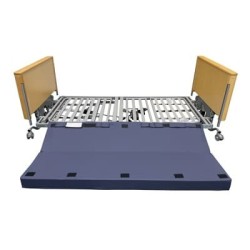


The Grab Handle Safety Sleeve covers the exposed gap sections of Harvest grab handles to reduce limb entrapment risk in line with MHRA bed safety guidance. Compatible with the Standard Grab Handle (NCL-HLB685), Ultimate Grab Handle (NCL-HLB686), and Ultra Low Grab Handle (NCL-HLDWUL685). Quick to fit and remove without tools. Durable materials suitable for the care environment. Supports CQC Regulation 12 compliance as a documented entrapment mitigation measure.
| Specification | Detail |
|---|---|
| Compatible Handles | Standard Grab Handle (NCL-HLB685); Ultimate Grab Handle (NCL-HLB686); Ultra Low Grab Handle (NCL-HLDWUL685) |
| Function | Covers exposed handle gaps to reduce limb entrapment risk |
| Fitting | Tool-free; quick fit and removal |
| Reference | NCL-HLBGHS |
| Compliance | Supports MHRA bed safety guidance on grab handle entrapment |
The Grab Handle Safety Sleeve supports compliance with MHRA bed safety guidance, which requires care providers to assess and mitigate entrapment risks at all bed-associated equipment including grab handles. The presence of the sleeve must be documented in the equipment register as a component of the bed setup, and its condition must be confirmed during routine bed inspections. Where a grab handle entrapment risk has been identified in the care setting's bed safety audit, the sleeve provides a proportionate and documented mitigation measure that should be recorded in CQC Regulation 12 compliance documentation. The sleeve must be confirmed correctly seated with no gaps at each inspection; displacement of the sleeve restores the entrapment risk and must be rectified immediately.
What types of entrapment risk does the grab handle safety sleeve address?
MHRA bed safety guidance identifies seven zones of entrapment risk between the mattress, the bed frame, the headboard, and the rails; grab handles create an additional entrapment zone at the handle-to-frame junction. The specific entrapment mechanism at a grab handle is typically wrist or forearm entrapment: a resident who reaches for the grab handle in the night may insert their arm through a gap in the handle frame, then become unable to withdraw it when their arm rotates or when the handle is gripped; this can cause the resident to become stuck in an uncomfortable or dangerous position until a carer is available to assist. The safety sleeve closes the exposed frame gaps at the handle, maintaining the functional grip surface of the handle while eliminating the open sections through which the arm can pass. The sleeve does not address all seven MHRA entrapment zones, which require assessment across the full bed and rail configuration; it specifically targets the grab handle entrapment zone as a proportionate intervention for that specific risk.
Should the safety sleeve be fitted to all grab handles as a standard precaution, or only when entrapment risk is identified?
The care provider's approach to grab handle sleeve deployment should be guided by the individual risk assessment for each resident rather than as a universal blanket measure. Under CQC Regulation 12 and MHRA bed safety guidance, the care provider is required to assess foreseeable risks and implement proportionate mitigation; for most residents using grab handles in the expected way, the handles function as intended and the entrapment risk is low. Where the risk assessment identifies specific factors that increase entrapment risk - such as a resident with confusion or dementia who explores the bed structure during the night, a resident with involuntary limb movements, or a resident whose arm dimensions are within the range where the handle gap creates a plausible entrapment pathway - the sleeve is the proportionate mitigation measure and should be fitted and documented. In settings where a pattern of grab handle entrapment incidents has been identified across the resident population, the provider may choose to fit sleeves as a standard precaution across all handles and document this as a population-level risk mitigation; however, this should be a conscious policy decision backed by the risk assessment rather than an assumption that fitting sleeves universally is always the appropriate response.