
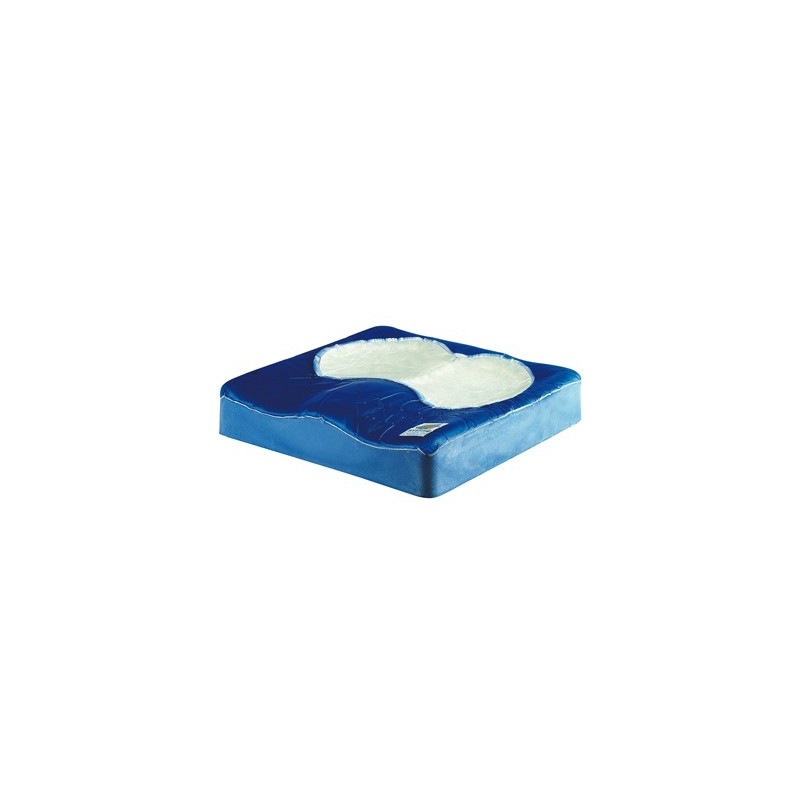

The Duoform Cushion provides medium-to-high-risk seated pressure redistribution using a two-part gel system using white fluid gel for active redistribution at high-pressure contact zones and blue viscoelastic gel for structural containment, on an anatomically moulded high-resilience foam base. Four sizes with SWLs from 110kg to 160kg. Welded breathable four-way stretch cover. Pairs with Prime Comfort Plus mattress for 24-hour care. MDR 2017/745 Class I medical device.
| Specification | Detail |
|---|---|
| NCL-P341C42421HF | 420 x 420 x 80mm - SWL 110kg (17 stone) |
| NCL-P341C45421HF | 450 x 420 x 80mm - SWL 120kg (18 stone) |
| NCL-P341C45461HF | 450 x 460 x 80mm - SWL 120kg (18 stone) |
| NCL-P341C51461HF | 510 x 460 x 80mm - SWL 160kg (25 stone) |
| Top Layer | 2-part gel: white fluid gel at high-risk zones + blue viscoelastic gel |
| Base | Anatomically moulded high-resilience foam |
| Cover | 4-way stretch welded highly breathable |
| Paired Mattress | Prime Comfort Plus (NCL-HSMPRIM) |
| Clinical Risk Level | Medium-high risk per NICE CG179 |
| Regulatory Status | MDR 2017/745 Class I medical device |
The Duoform Cushion is a Class I medical device under MDR 2017/745. Clinical selection requires occupational therapist assessment confirming medium-to-high-risk seating need per NICE CG179. SWL must be verified per MHOR 1992 for the specific size selected; the correct anatomical orientation of the cushion in the seat must be confirmed at issue - the moulded base has a specific orientation and must be placed correctly to align the gel zones with the resident's anatomical landmarks. Equipment register records and MDR conformity documentation must be maintained for CQC Regulation 12 compliance.
Why are two different types of gel used in the same cushion, and what does each one do?
The two-part gel design addresses a limitation of using a single gel type across the entire cushion surface. Fluid gel has very low internal resistance to flow, which makes it highly effective at redistributing pressure under point loads at bony prominences - the gel flows away from the high-pressure zone and raises around the lower-pressure surrounding area, distributing load very effectively. However, if the entire cushion surface is fluid gel, the gel migrates too freely under the resident's full body weight during prolonged sitting, causing the gel to thin dramatically under the heaviest contact zones and thicken excessively at the periphery, reducing overall pressure redistribution effectiveness over time. The blue viscoelastic gel has higher internal resistance to flow, which makes it better at holding its position and providing stable structural support across the broader seat surface, but less effective at the maximum pressure redistribution required at the ischial tuberosities. The Duoform places the fluid gel precisely where maximum pressure redistribution is needed (over the bony prominence contact zones) and uses the visco gel at the surrounding area to contain the fluid gel laterally and prevent its excessive migration, combining the strengths of both materials in a single surface.
What does the anatomically moulded foam base contribute to pressure redistribution, and how is the cushion correctly oriented?
The anatomically moulded foam base has contours built into its upper surface that correspond to the typical shape of the posterior seated anatomy - slightly raised support zones at the posterior thigh areas flanking the ischial tuberosities, and a recessed zone at the centre ischial contact area. When the moulded base is correctly oriented with the resident's anatomy, these contours increase the contact area between the foam surface and the soft tissue surrounding the ischial tuberosities, distributing the seated load more evenly across the base surface before it reaches the gel layer above. A flat base provides only the contact that the gel layer creates, while the moulded base adds anatomical contact support below the gel, which allows the gel to remain thicker and more uniform in the clinical zones even under prolonged load. The correct orientation is typically indicated by a label or marking on the cushion; the occupational therapist must confirm the correct orientation during prescription and instruct care staff accordingly. An incorrectly oriented moulded cushion places the anatomical contours at the wrong zones relative to the resident's seated position, compromising the pressure redistribution performance and potentially increasing pressure at sites that should be relieved.
