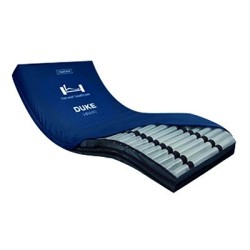


The Community Static Mattress provides medium-risk pressure redistribution using a CMHR foam construction meeting BS7177 institutional fire safety requirements for residential and care home settings. The turnable design extends service life by distributing wear across both faces. The four-way stretch vapour-permeable PU cover supports skin microclimate management and NHS IPC decontamination. Available in 900mm and 1200mm widths and in vandal-proof variants. SWL 159kg. Designed for profiling beds per NICE CG179 medium-risk assessment.
| Specification | Detail |
|---|---|
| NCL-HSMCOM | 2000 x 900 x 125mm - Standard |
| NCL-HSMCOM.12 | 2000 x 1200 x 125mm - Wide (1200mm bed) |
| NCL-HSMCOM.VP | Vandal-proof variants in both sizes |
| Foam Type | CMHR (combustion modified high-resilience) |
| Cover | 4-way stretch VP PU - water resistant, stitched seams |
| Turnable | Yes - to extend service life |
| Safe Working Load | 159kg (25 stone) |
| Fire Standard | BS7177 (CMHR foam) |
| Clinical Risk Level | Medium risk per NICE CG179 |
The Community Static Mattress is a Class I passive medical device under Medical Devices Regulation 2017/745. Clinical selection requires validated pressure risk assessment per NICE CG179 confirming medium-risk status; for residents assessed at high or very high risk, the Community Plus or an active alternating mattress must be selected. SWL must be verified against the resident's documented weight per MHOR 1992. CMHR foam meets the BS7177 institutional fire safety standard required for care home use under the Regulatory Reform (Fire Safety) Order 2005. The VP cover supports NHS IPC decontamination between residents. Equipment register records including SWL verification and MDR conformity documentation must be maintained for CQC Regulation 12 compliance.
What is the clinical difference between the Community and Community Plus static mattresses, and when does each apply?
The Community Static Mattress is indicated for residents assessed at medium pressure risk per NICE CG179 - typically a Waterlow score in the moderate range who are mobile enough to reposition independently with prompting and who spend limited time in bed. The Community Plus is indicated for residents assessed at high risk, with a higher-specification CMHR foam that provides greater pressure redistribution capacity and a higher SWL of 190kg compared to 159kg on the Community. The key clinical decision point is the NICE CG179 risk assessment: a resident who is at medium risk and expected to remain so is appropriately supported by the Community mattress; a resident who is at high risk, has limited mobility, or is likely to deteriorate to high risk should be prescribed the Community Plus from the outset to avoid a mattress change at a clinically sensitive time. Neither mattress is appropriate for very high-risk residents or those with existing stage 3 or 4 pressure injuries, who require an active alternating system.
When is the vandal-proof variant indicated, and does it affect pressure care performance?
The vandal-proof variant uses a reinforced cover construction that is more resistant to tearing, cutting, or deliberate damage than the standard cover. It is indicated in secure residential settings, specialist dementia units, or care homes where residents with challenging behaviour or reduced capacity may pick, pull, or cut at standard PU covers, compromising the fluid-resistant surface and the foam beneath. The reinforced construction does not alter the CMHR foam or its pressure redistribution characteristics, so pressure care performance is equivalent to the standard variant. The trade-off is typically a slightly reduced flexibility in the cover, which may marginally affect the conforming of the four-way stretch; this is not clinically significant for medium-risk static pressure care. The choice of vandal-proof variant should be made based on individual risk assessment of the resident's behaviour and the setting's equipment damage history, rather than as a blanket procurement decision for all residents.