
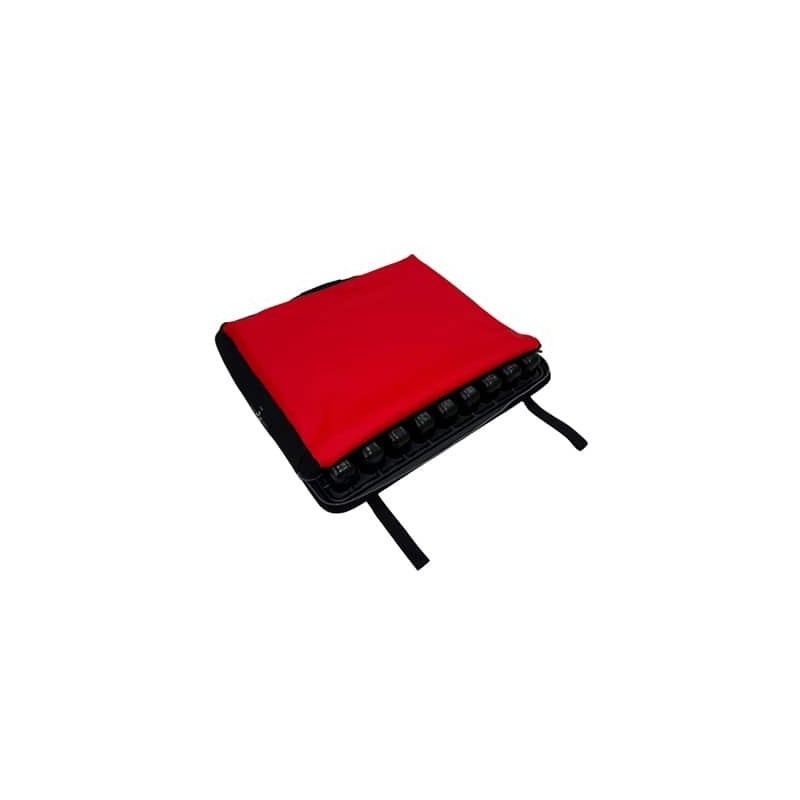


The AirSet is a self-inflating hybrid seating cushion combining a foam core with integrated air compartments that dynamically adapt to the resident's movements without requiring a pump or external power. The air compartments self-inflate when load is removed and deflate progressively under seated weight, providing continuous passive pressure redistribution. The ventilation effect of the self-inflating air compartments manages heat and moisture at the seated skin surface. Wipe-clean and washable. SWL 150kg. 440 x 440 x 80mm; 2kg. High-risk seating per NICE CG179; MDR 2017/745 Class I medical device.
| Specification | Detail |
|---|---|
| Type | Hybrid foam-air self-inflating seating cushion |
| Self-Inflation | Automatic - no pump or power required |
| Dimensions | 440 x 440 x 80mm |
| Weight | 2kg |
| Safe Working Load | 150kg (approximately 24 stone) |
| Cover | Wipe-clean surface; washable design |
| Reference | NCL-HHC001 |
| Regulatory Status | MDR 2017/745 Class I medical device |
| Clinical Risk Level | High risk per NICE CG179 |
The AirSet Cushion is a Class I medical device under Medical Devices Regulation 2017/745. Clinical selection must follow occupational therapist assessment of seating pressure risk per NICE CG179, with the high-risk indication confirmed. SWL of 150kg must be verified against the resident's documented weight before clinical issue per MHOR 1992. Equipment register documentation including MDR conformity records must be maintained for CQC Regulation 12 readiness. Clinical review must be scheduled at regular intervals to confirm the cushion remains appropriate as the resident's condition and seating requirements evolve.
How does the self-inflating mechanism work, and does it require any maintenance or adjustment?
The self-inflating mechanism uses open-cell foam compartments that are enclosed within an airtight membrane. When the resident stands or shifts weight off the cushion surface, the foam's natural elasticity causes the compartments to expand and draw air in through the valve system, inflating the air compartments. When the resident sits back down, their weight compresses the foam and air compartments progressively, deflating them slowly as the seated load increases. This inflation-deflation cycle happens with every significant weight shift and provides a continuous passive dynamic response to the resident's movement pattern. The mechanism requires no external power, pump, or calibration, and the maintenance requirement is limited to: checking valve function during routine cleaning by confirming the cushion self-inflates fully within a few minutes when removed from seated use; inspecting the outer surface for damage that would allow air to escape from the compartments; and laundering the washable cover per the care setting's schedule. If the cushion no longer self-inflates to its full profile, a valve or membrane failure has likely occurred and the cushion must be replaced rather than repaired.
When is the AirSet preferred over a foam-only cushion such as the Maximise range, and is it suitable as the only seating cushion?
The AirSet is preferred over a foam-only cushion when the resident's clinical assessment identifies two concurrent priorities: high-risk pressure redistribution and thermal or moisture management at the seated skin interface. A foam-only cushion from the Maximise range provides excellent structural pressure redistribution through foam density and geometry but provides less dynamic microclimate adaptation than the AirSet's self-inflating air compartments. The AirSet's self-inflating cycle also provides a form of dynamic offloading at each weight-shift event that a static foam cushion does not, which may be beneficial for residents who shift position frequently but cannot tolerate the controlled cycle of a powered alternating cushion. The AirSet is suitable as the primary seating cushion for residents assessed at high risk; it should not be used as a supplementary layer over another seating cushion, as the self-inflating mechanism requires the cushion to form the top contact surface. For residents assessed at very high risk with existing pressure injuries in the seated zone, the prescribing clinician should review whether the AirSet's self-inflating performance is sufficient for the clinical need or whether a higher-specification seating device is required.
